
WORK PERMIT IN TURKEY (2026)
The Complete Guide for Foreign Employees, Employers and Investors
55 Official Questions Answered · Step-by-Step Process · Fees, Documents, Deadlines and Practical Tips
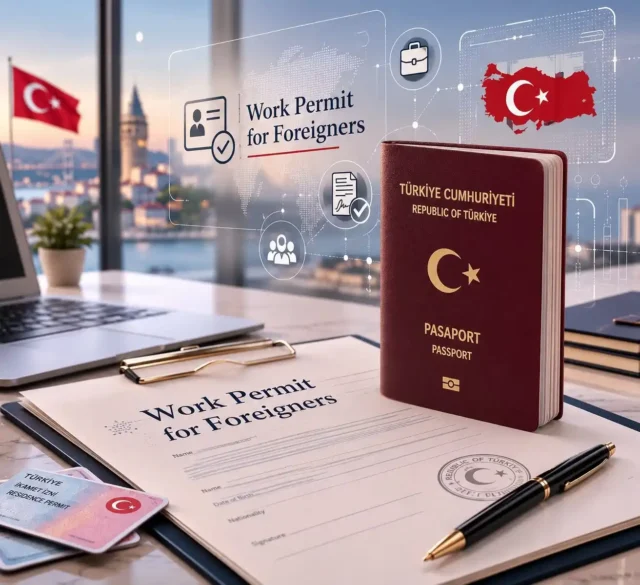
Quick answer: A work permit (çalışma izni) is the official document that allows a foreign national to work legally in Turkey. It is issued by the Ministry of Labour and Social Security, normally serves as a residence permit at the same time, and is usually granted for 1 year on first application. Applications are filed online through the e-İzin system — from within Turkey by the employer, or from abroad through a Turkish embassy or consulate. A complete application is decided within 30 days. This guide answers every question you are likely to have, based on the official responses of the Ministry of Labour and Social Security.
Turkish Work Permit at a Glance
| Item | Key Facts |
|---|---|
| Issuing authority | Ministry of Labour and Social Security (Çalışma ve Sosyal Güvenlik Bakanlığı) |
| Governing law | International Labour Force Law No. 6735 |
| Where to apply | Online, via the e-İzin system (from within Turkey) or via a Turkish embassy/consulate + e-İzin (from abroad) |
| Processing time | 30 days from the date all documents are uploaded in full |
| First permit duration | Generally 1 year, tied to a specific employer and role |
| Extensions | Up to 2 years on first extension, up to 3 years on subsequent extensions (same employer) |
| Counts as residence permit? | Yes, in most cases — no separate residence permit is needed |
| If rejected | Objection within 30 days via e-İzin; administrative court action if the objection is refused |
| Deadline to start work | Within 1 month (domestic applications); within 1 month of entry and max. 6 months of permit start (applications from abroad) |
Everything in the tables and answers below reflects the official position of the Ministry of Labour and Social Security. Where practical thresholds (capital, fees, salary levels) are updated periodically by the Ministry, we say so clearly and tell you where to verify the current figures — or you can simply ask us.
Who Needs a Work Permit in Turkey?
Every foreign national who works in Turkey in principle— as an employee, a company manager or a self-employed professional — must hold either a work permit or a work permit exemption before starting work. A residence permit alone is not enough: it gives you the right to live in Turkey, not the right to work here.
This rule applies equally to remote-style arrangements performed for a Turkish employer, part-time roles and short engagements. The only people who can work without a permit are those covered by a specific statutory exemption (for example Blue Card holders — see Questions 27–29 below).
Why it matters: Working without a permit exposes both the employee and the employer to administrative fines, and the foreign national is reported to the Ministry of Interior for deportation. A deportation record can block future residence, work permit and even citizenship applications. Getting the permit right the first time is always cheaper than fixing a violation.
Employer Eligibility: The Criteria the Ministry Actually Applies
Many guides list the documents but skip the part that decides most applications: the evaluation criteria applied to the sponsoring employer. Before you apply, check that the Turkish company meets the following conditions (as most recently published by the Ministry — these thresholds are updated from time to time, so always confirm the current figures before filing):
- Employment ratio (“5-to-1 rule”): the workplace must employ at least five Turkish citizens registered with the Social Security Institution (SGK) for each foreign employee. For newly established companies, this criterion is applied flexibly during the first six months. Companies whose net sales in the last year reached TRY 50,000,000 or more may employ up to five foreign nationals without this ratio being applied.
- Financial standing: newly established companies are expected to show paid-in capital of at least TRY 500,000. Operating companies must meet at least one of: TRY 500,000 paid-in capital, approximately TRY 8,000,000 in annual net sales, or exports of roughly USD 150,000 in the previous year.
- Foreign shareholders: if the foreign applicant is a partner in the company, a minimum shareholding (generally at least 20% of the shares) is expected.
- Realistic salary: the declared salary must match the position. The Ministry applies minimum gross salary thresholds expressed as multiples of the Turkish minimum wage — higher multiples for senior managers, engineers and architects, lower for other qualified roles. A senior title on a minimum-wage salary is a classic red flag that leads to rejection.
- Compliance: the employer should be up to date with tax and social security obligations, and the workplace must be genuinely operating.
Practical tip: Roughly half of the rejections we see are employer-side problems — capital below the threshold, the 5:1 ratio not met on the SGK records, or an unrealistic declared salary. A 30-minute eligibility check before filing prevents a 30-day wait for a rejection letter.
The Application Process, Step by Step
Path 1 — Applying from Abroad
- Step 1: The foreign national applies in person to the Turkish embassy or consulate in their country of citizenship or legal residence and receives a reference number.
- Step 2: The employer in Turkey uses that reference number to complete the work permit application in the electronic system (e-İzin), uploading all company and employee documents.
- Step 3: The Ministry evaluates the application — 30 days if the file is complete.
- Step 4: On approval, the applicant pays the work/residence permit fee and visa fee at the consulate, receives the work visa in their passport, and can enter Turkey.
- Step 5: After entry, register in the address registration system within 20 days at the latest. The work permit card is printed by the Ministry and delivered by PTT to the employer’s address.
Path 2 — Applying from Within Turkey
- Available to foreign nationals who already hold a valid residence permit (and to certain categories determined by the Directorate General who are legally present in Turkey even without a residence permit).
- The employer files the application directly through e-Devlet / the e-İzin system — no consulate stage is needed.
- The Ministry evaluates the application within 30 days of a complete file. On approval, the foreign national must start work within 1 month of the permit’s start date.
Typical Timeline
| Stage | Application from Abroad | Application from Within Turkey |
|---|---|---|
| Document preparation, translation, notarisation | 1–3 weeks (often the longest stage) | 1–2 weeks |
| Consulate application + reference number | Varies by consulate | Not required |
| Employer’s online application | 1–2 days once documents are ready | 1–2 days once documents are ready |
| Ministry evaluation | 30 days from complete upload | 30 days from complete upload |
| Visa fees, work visa, entry to Turkey | 1–3 weeks | Not required |
| Start of work | Within 1 month of entry (max. 6 months of permit start) | Within 1 month of permit start |
Plan backwards: If you need an employee at their desk on a specific date, count backwards at least 8–10 weeks for an application from abroad. Document legalisation and translation regularly takes longer than the Ministry’s own 30-day review.
55 Official Questions and Answers on Work Permits in Turkey
The answers below are based on the official responses published by the Ministry of Labour and Social Security. We have organised them by topic so you can find what you need quickly, and translated them into clear English. Where our team can add a practical note from day-to-day case experience, we have marked it separately so official information and practical commentary are never mixed.
The Basics: What a Work Permit Is and Why You Need One
1. What is a work permit?
A work permit is the official authorisation document that allows foreign nationals to work legally in Turkey. It is issued by the Ministry of Labour and Social Security and, throughout its validity period, gives the foreign national both the right to work and the right to reside in Turkey.
Foreign nationals found to be working without a work permit — and the employers who employ them — are subject to administrative fines. In addition, foreign nationals working without a work permit are reported to the Ministry of Interior for deportation.
2. Does a work permit replace a residence permit?
Yes, in most cases it does.
A work permit issued under the International Labour Force Law No. 6735 is deemed equivalent to a residence permit under the Law on Foreigners and International Protection No. 6458.
- Applicants for international protection
- Conditional refugees
- Persons under temporary protection
Work permits issued for the categories above are not treated as residence permits.
3. Is a residence permit alone enough to work in Turkey?
No. A residence permit gives a foreign national the right to stay in Turkey legally, but it does not grant the right to work. To work legally in Turkey, you must additionally hold a work permit or a work permit exemption.
4. Can I apply on my own, without professional help?
Of course. The Ministry of Labour and Social Security publishes all guides and required information about the application process on its official website, and information is also available through the ALO 170 helpline.
That said, many foreign employees and investors prefer to obtain professional legal support to ensure the process moves forward completely and quickly.
Types of Work Permits in Turkey
5. What is a definite-term (employer-tied) work permit?
A definite-term (employer-tied) work permit is the type of permit issued for work with a specific employer.
If the application is approved, the permit is issued:
- for a period not exceeding the term of the employment or service contract,
- in the name of a specific employer,
- for a maximum of 1 year on the first application.
6. What is an indefinite (permanent) work permit?
An indefinite work permit is issued in the foreign national’s own name, without being tied to a specific employer, and grants an unlimited right to work and reside in Turkey.
The following persons may apply:
- Foreign nationals holding a long-term residence permit in Turkey,
- Foreign nationals who have worked legally under a work permit for at least 8 years.
Meeting these conditions does not, however, guarantee that an indefinite work permit will be granted.
Indefinite work permit cards are renewed every 5 years from the start date of the permit. The card renewal application must be made within the final 6 months before the five-year period expires, and in any event before it expires.
7. What is an independent work permit?
An independent work permit allows a foreign national to work in Turkey in their own name and on their own account.
When evaluating the application, the following are taken into account in line with international labour force policy:
- level of education,
- professional experience,
- contribution to science and technology,
- the impact of the investment or activity on the Turkish economy and employment,
- the capital share, if the applicant is a partner in a foreign company,
- other similar criteria.
Independent work permits are issued for a definite term.
Documents and How to Apply
8. Which documents are required for a work permit application?
In general, the following documents are requested:
- An employment contract signed by both the employer and the foreign national,
- A copy of the passport,
- A Turkish translation of the diploma or provisional graduation certificate, certified by a sworn translator or official authorities,
- The Turkish Trade Registry Gazette showing the company’s latest capital and shareholding structure,
- The most recent balance sheet and profit/loss statement, approved by the tax office or a sworn financial advisor.
The required documents may vary depending on the field of activity. Sector-specific document lists and up-to-date details are published on the Ministry’s relevant page.
9. How is a work permit application filed?
Applications are made through the Work Permit Application System for Foreigners (e-İzin).
Application from within Turkey: For foreign nationals holding a valid residence permit, the application can be filed by the employer via e-Devlet. In addition, certain foreign nationals determined by the Directorate General can apply through the system without a valid residence permit, provided they are legally present in Turkey.
Application from abroad: Applications from abroad take place in two stages. Stage 1: the foreign national applies to the Turkish Embassy or Consulate General in their country and is given a reference number. Stage 2: the employer in Turkey completes the work permit application through the electronic system using this reference number.
10. How is a work permit application evaluated?
Applications are examined in line with the work permit evaluation criteria determined by the Ministry of Labour and Social Security and international labour force policy. If the information and documents are complete, the evaluation process is finalised within 30 days. This period starts on the date the information and documents requested by the Ministry are uploaded to the system in full. Where deemed necessary, the opinions of relevant public institutions and organisations may also be sought.
11. How will I be notified of the result?
The positive or negative outcome of the application is sent to the e-mail address provided during the application. For applications filed from abroad, the result is also transmitted online to the relevant Turkish mission. The status and result of the application can also be tracked through the e-İzin system.
If Your Application Is Rejected
12. What can I do if my application is rejected?
If a work permit application is rejected, you have the right to object within 30 days. The objection is filed online through the e-İzin system, with a reasoned petition and supporting documents uploaded to the system. If the Ministry also rejects the objection, you may take the matter to the administrative courts.
13. Can I re-apply after a rejection?
Yes.
Once the deficiency or ground that caused the rejection has been remedied, a new work permit application can be filed.
After Approval: Your First Steps
14. How soon must the foreign national start working once the permit is issued?
Social security obligations for foreign nationals holding a work permit must be fulfilled in line with the salary and full-time employment terms declared in the application.
For applications filed from within Turkey, the foreign national must start work within 1 month of the work permit’s start date.
For applications filed from abroad, the foreign national must start work within 1 month of entering Turkey and, in any event, within 6 months of the work permit’s start date.
15. For applications from abroad, what must be done after the permit is approved?
Once the work permit is approved, the foreign national must:
- Go to the Turkish mission where they applied and pay the work and residence permit fee and the visa fee,
- Note that if the work permit fee and valuable paper fee are not paid within 30 days of notification, the application is rejected,
- Enter Turkey once the work visa has been stamped in their passport.
The work permit card issued by the Ministry is sent to the employer’s address via PTT.
After entering Turkey on a work visa, the foreign national must register in the address registration system within 20 days at the latest.
The first work permit is generally issued for 1 year, although this may vary depending on the type of permit, the employment contract and the employer’s situation.
16. My work permit card has not arrived yet. How can I track it?
PTT sends information messages about the delivery status to the mobile phone number registered in the system. You can also track the card via e-Devlet:
Application Procedures → Finalised Applications → Post-Permit Procedures → Card Tracking.
17. What should I do if I lose my work permit card?
If the card is lost, stolen or damaged beyond use, you can request a new card from the Ministry.
To do so, log into the e-İzin system via e-Devlet and follow: Application Procedures → Finalised Applications → Post-Permit Procedures → New Card Request.
If the request is approved, the foreign national is asked to pay the valuable paper fee plus a fee equal to half of the work permit fee. Once payment is complete, the new work permit card is sent to the workplace address.
Extending Your Work Permit
18. Can a work permit be extended?
Yes, it can.
An extension application can be filed before the work permit expires. Applications can begin 60 days before the permit’s expiry date and must, in any event, be completed through the system before the permit expires. If the extension application is approved, employment with the same employer can continue.
19. For how many years can a work permit be extended?
If the extension application is assessed positively, the foreign national is granted a work permit with the same employer for up to two years on the first extension application, and for up to three years on subsequent extension applications.
20. Can I keep working while my extension application is being processed?
Foreign nationals for whom an extension application has been filed may continue to work from the date their permit expires, for the duration of the evaluation and in any event for no more than 90 days, provided the job and workplace remain unchanged. Work performed during this period is considered lawful employment, and the rights and obligations of both the foreign national and the employer arising from the work permit continue in the same way.
The Legal Framework
21. What is the main legislation currently in force on work permits?
The principal legislation on work permits is:
- International Labour Force Law No. 6735,
- Implementing Regulation of the International Labour Force Law,
- Turquoise Card Regulation,
- Regulation on the Employment of Applicants for International Protection and Holders of International Protection Status,
- Regulation on Work Permits of Foreigners under Temporary Protection,
- Regulation on Work Permits of Foreigners to Be Employed in Free Zones,
- Regulation on the Employment of Foreign Personnel in Direct Foreign Investments.
22. Who is covered by the International Labour Force Law No. 6735?
Law No. 6735 covers:
- Foreign nationals who apply to work or receive vocational training in Turkey, or who are already doing so,
- Foreign nationals who wish to complete, or are completing, an internship,
- Cross-border service providers present in Turkey to provide services on a temporary basis,
- Natural and legal persons who employ, or wish to employ, foreign nationals.
Provisions of bilateral or multilateral international agreements and international conventions to which Turkey is a party are reserved.
Who Does Not Need a Work Permit? Exemptions and Special Statuses
23. Which foreign nationals do not need a work permit?
Some foreign nationals may work without a work permit under special laws or international agreements to which Turkey is a party. For example:
- Blue Card (Mavi Kart) holders (Turkish Citizenship Law No. 5901),
- Persons with refugee or subsidiary protection status (Law No. 6458),
- Members of diplomatic missions (1961 Vienna Convention on Diplomatic Relations and 1963 Vienna Convention on Consular Relations).
24. Do Blue Card holders have to obtain a work permit?
No, they do not.
Persons who lost Turkish citizenship after obtaining renunciation permission from the Ministry of Interior — and their descendants up to the third degree who hold a Blue Card or can document their registration in the Blue Card Registry — may work in Turkey without a work permit.
No work permit is issued in their name. However, upon request, a fee-exempt document confirming that they may work in Turkey can be issued.
25. Do foreign company shareholders and board members need a work permit?
For companies established under the Turkish Commercial Code No. 6102, the answer depends on the person’s role in the company.
The following must obtain a work permit to work:
- Managing directors of limited liability companies who are also shareholders,
- Board members of joint-stock companies who are also shareholders,
- Managing general partners of partnerships limited by shares.
By contrast, the following fall within the scope of the work permit exemption:
- Board members of joint-stock companies who do not reside in Turkey,
- Company shareholders who do not hold a managerial role.
26. Can applicants for international protection and conditional refugees obtain a work permit?
Yes.
Applicants for international protection and persons with conditional refugee status must obtain a work permit before starting work. The application can be filed 6 months after the date of the international protection application. For persons subject to an obligation to reside in a specific province, work permit applications for a different province are evaluated after obtaining the opinion of the Ministry of Interior.
27. Is a Turkish-employee requirement applied in qualifying direct foreign investment companies?
Not always. In companies that meet the criteria for direct foreign investments of special significance, the employment criterion is not applied when evaluating the work permit of the first foreign national to be employed as key personnel. In other words, the requirement to employ 5 Turkish citizens per foreign national is not sought for the first foreign employee.
Restricted Professions: Jobs Foreign Nationals Cannot Do
28. Can foreign nationals work in any profession they choose in Turkey?
No. Work permit applications are evaluated by taking into account the needs of the Turkish labour market, employment policies, economic conditions and developments in working life.
In addition, certain professions and duties are reserved by law exclusively for Turkish citizens. Work permits cannot be issued to foreign nationals in these fields.
The main professions and duties reserved for Turkish citizens are:
- Founders, managers, trainers and authorised corporate representatives of private security companies
- Private security guards
- Neighbourhood and market watchmen (bekçi)
- Certified public accountancy (mali müşavirlik)
- Members of cooperative boards of directors
- Assistant customs brokers
- Founders of schools established by foreigners that teach in a language other than Turkish
- Responsible directors (mesul müdür) of private hospitals
- Dentistry
- Patient care attendants (hastabakıcı)
- Pharmacy
- Veterinary medicine
- Foreign assistant physicians working outside specialty training
- Notaries
- Judges and prosecutors
- Attorneys (avukat)
- Mediators
- Court experts (bilirkişi)
- Concordat commissioners
- Trainee aviation information management officers
- Honorary traffic inspectors
- Freight forwarding organisation (taşıma işleri organizatörlüğü)
- Agency managers and travel agency managers
- Tourist guides
- Activities within Turkish territorial waters under the Cabotage Law: fishing; exporting oysters, mussels, sponges, pearls and coral; diving, salvage, pilotage, ship captaincy, engineering, clerkship, seamanship and similar activities
- Sports consultants
- Labour intermediaries in agriculture
- Ship agency officials and ship agency personnel
- Permanent supervisors and technical staff (mining)
The legal basis for these restrictions is the citizenship requirement contained in the relevant special laws and regulations.
Working Rules: Changing Jobs, Rights and Obligations
29. Can a foreign national with a work permit work in any job?
No. A definite-term (employer-tied) work permit is issued for a specific employer and a specific job. The foreign national may therefore only work at the workplace and within the role stated on the permit document.
30. Can a foreign national with a work permit change employers?
A foreign national cannot work for a different employer under their existing work permit. A foreign national who wishes to move to a different employer must obtain a new work permit.
However, within the same employer, the following are possible provided the necessary conditions are met:
- working in a different role, or
- being assigned to another branch in the same line of business.
31. What rights does a foreign employee have in case of illness or a work accident?
Foreign nationals holding a work permit also benefit from the provisions of the relevant legislation in the event of illness or a work accident.
32. What is the notification obligation?
Employers who employ foreign nationals, and foreign nationals holding an independent work permit, are obliged to notify the Ministry of Labour and Social Security within 15 days of the start of employment, the end of employment, and any situation requiring the cancellation of the work permit or work permit exemption.
33. Can foreign employees in Turkey join a trade union?
Yes. There is no legal obstacle preventing foreign nationals working in Turkey under a work permit from becoming members of a trade union.
34. Where can I find statistics on work permits for foreign nationals?
Up-to-date statistics on work permits are published regularly by the Ministry of Labour and Social Security. Figures on foreign employees, sector distributions and annual statistics are available in the “Statistics” section of the Ministry’s website.
Fees: How Much It Costs and How to Pay
35. Is a fee payable for a work permit?
Yes. Under the Fees Law No. 492, work permit and work permit exemption applications are subject to a fee. In addition, a valuable paper fee is charged for work permit and work permit exemption documents under the Valuable Papers Law No. 210. There are, however, some exceptions:
- No fee is charged for work permit exemption applications shorter than three months,
- Turquoise Card holders do not pay the work permit fee; only the valuable paper fee is collected.
Current fee and valuable paper amounts are published on the website of the Ministry of Labour and Social Security.
36. How are the work permit fee and valuable paper fee paid?
Payments can be made through the Digital Tax Office using the “Payment by Reference Number” screen. During payment:
- Select “Directorate General of International Labour Force” as the institution,
- Enter the Foreigner Identification Number (the number starting with 9),
- Use the Reference (Transaction ID) Number sent by e-mail during the application.
If payment will be made in Turkey, it can also be completed through the contracted banks: T.C. Ziraat Bankası, T. Halk Bankası and T. Vakıflar Bankası.
Payments must be made in full and in the exact amount to the notified account codes. If an underpayment or overpayment is made, the application cannot be finalised.
The account codes are: for the Work Permit Document — work permit fee: 9130, valuable paper fee: 926; for the Work Permit Exemption Document — fee: 9280, valuable paper fee: 9268.
There is no need to send the receipts to the Ministry separately: payments are displayed automatically in the system.
Using the e-İzin System: Practical Answers
37. What technical requirements does the e-İzin system have?
For the e-İzin system to work smoothly, the Google Chrome browser is recommended. To avoid problems with electronic signature transactions, pop-up windows must be allowed in the browser.
38. Who creates the workplace record in e-İzin? Can application authority be delegated?
The employer record in the e-İzin system is created by the employer’s e-Bildirge user registered with the SGK. Once registration is complete, one or more persons can be authorised to file applications by entering their Turkish ID number under “Employer Management Panel” → “Authorisation Procedures”. Authorised persons can then file work permit applications on behalf of the workplace through the system.
39. Can more than one person be authorised to apply on behalf of a workplace?
Yes. After the employer record is created by the workplace’s e-Bildirge user, one or more persons can be authorised through the system to file applications on behalf of the workplace. There is no limit on the number of persons who may be authorised.
40. Can the employer update workplace information in the e-İzin system?
Yes. The workplace’s e-Bildirge user can update workplace information other than the data transferred automatically from the SGK. Information coming from the SGK can only be changed by updating the SGK records themselves.
41. How is the foreign national’s job title selected in the system?
During the application, when at least three letters of the intended job are typed into the role field, the system lists the matching job titles. Select the title that matches the employment contract to complete the application.
42. What should be done if the SGK registration number has 23 digits?
Work permit applications require a 26-digit SGK registration number. If the workplace is a principal employer, add 000 after the 23 digits. For sub-employers, the missing digits should be obtained from the relevant Provincial Directorate of Social Security.
43. Are there limits on the documents uploaded to the system?
Documents uploaded to the e-İzin system must be in PDF format and no larger than 2 MB.
44. What are the photo requirements for the application?
The photo must be in jpeg, jpg, png or gif format; taken within the last 6 months; in colour; front-facing; with the face fully visible; and on a white (biometric) background.
45. What if the system will not proceed at the “Save” stage after uploading documents?
First check that a green confirmation mark appears next to every tab. Tabs without the confirmation mark contain missing information.
If all information is complete but the electronic signature screen does not open: make sure the browser’s pop-up feature is enabled, and use Google Chrome for the system to work more reliably.
46. What does an “incomplete application” mean?
Even if all the information in an application has been entered, the application does not count as completed until it is approved with an electronic signature. Such applications are saved in the “Incomplete Applications” section of the system. The status of applications can be tracked from the Application Tracking Procedures menu.
47. Do I need to send paper documents after applying?
No. All procedures in the e-İzin system are carried out electronically. For applications completed with an electronic signature, there is no need to send paper documents to the Ministry.
48. How do I upload a document if I receive a missing-document notification?
Prepare the requested document in PDF format. Then select the relevant application under Application Tracking Procedures → Applications Under Evaluation and upload the document to the system. After uploading, approve the submission with an electronic signature.
Hiring Foreign Domestic Workers and Caregivers
49. Can foreign nationals be employed in domestic services?
Yes. A work permit application can be filed with the Ministry of Labour and Social Security to employ a foreign national in domestic services for the purposes of:
- childcare,
- elderly care,
- care of persons with disabilities,
- patient companionship.
50. Can a first-degree relative act as the employer in domestic care?
Yes.
If the elderly or disabled person is not in a position to file the application themselves, a first-degree relative may apply as the employer. In that case:
- the workplace record is created with the first-degree relative’s details,
- the address where the care will be provided is entered into the system during the application,
- in addition to the contract, a document showing the family relationship and a copy of the ID of the person to be cared for are uploaded to the system.
Special Cases: Healthcare Professionals, Passports and Cancellation
51. Can foreign doctors and nurses obtain a work permit in Turkey?
Yes.
Decree-Law No. 663 allows foreign doctors and nurses to work in Turkey. First, a preliminary authorisation certificate must be obtained from the Ministry of Health; a work permit application is then filed with the Ministry of Labour and Social Security.
Persons who graduated abroad must additionally submit a diploma equivalence certificate.
52. Is the passport’s validity taken into account when setting the permit duration?
Yes. The work permit is issued for a period 60 days shorter than the validity of the foreign national’s passport or passport-substitute document. It is therefore important to check that the passport’s validity is sufficient before applying.
53. Does renewing my passport invalidate my work permit?
No. Renewing your passport does not invalidate your work permit. However, any changes to your passport details must be notified to the Ministry of Labour and Social Security. This keeps the work permit records up to date and prevents administrative problems later on.
54. What must be done if the foreign national never starts work, or leaves the job?
In that case, the employer must request the termination of the work permit through the e-İzin system. The procedure is completed with an electronic signature under Post-Permit Procedures → Permit Termination Request.
55. Can a work permit be cancelled?
Yes. If the conditions set out in the law cease to exist, or other circumstances foreseen in the legislation arise, the work permit may be cancelled by the Ministry. It is therefore very important for both the foreign employee and the employer to act in compliance with the relevant legislation throughout the permit’s validity.
The 7 Most Common Reasons Work Permit Applications Are Rejected — and How to Avoid Them
The Ministry does not publish a rejection checklist, but after handling foreign-employment files since 2013 we see the same problems again and again. Check these before you file:
| Rejection Reason | What Goes Wrong | How to Avoid It |
|---|---|---|
| 5-to-1 ratio not met | The SGK records show fewer than five Turkish employees per foreign worker at the workplace. | Verify active SGK headcount before filing; plan hires or use the exemptions (new companies’ first 6 months; TRY 50M net sales rule). |
| Insufficient financial standing | Capital, net sales or exports fall below the current thresholds. | Check the latest Ministry criteria; register a capital increase before applying if needed. |
| Unrealistic salary | A qualified role is declared at or near minimum wage. | Declare a salary consistent with the Ministry’s minimum-wage multiples for the role — and actually pay it through SGK. |
| Incomplete or defective documents | Missing translations, expired trade registry data, unsigned contracts, files over 2 MB. | Use a pre-filing checklist; have every translation certified; check every e-İzin tab shows a green mark. |
| Role/qualification mismatch | The diploma and experience do not support the declared job title. | Choose the system job title that genuinely matches the contract and the applicant’s documented qualifications. |
| Restricted profession | The role falls within a profession reserved for Turkish citizens. | Screen the role against the restricted list (Question 30) before signing any contract. |
| Passport validity too short | The permit would exceed the passport validity minus 60 days. | Renew the passport before applying if less than about 14 months of validity remain. |
If you are rejected: Do not simply re-file the same application. Read the reasoning, fix the specific ground for rejection, and decide strategically between a 30-day objection and a fresh application. Filed correctly, an objection with new supporting evidence frequently succeeds — and if it does not, the administrative courts remain open.
Pre-Application Checklist
For the Employer
- Confirm the workplace’s active SGK headcount meets the 5-to-1 ratio (or that an exemption applies).
- Confirm paid-in capital / net sales / export figures meet the current Ministry thresholds.
- Prepare the latest Trade Registry Gazette showing capital and shareholding.
- Prepare the tax-office or sworn-financial-advisor approved balance sheet and profit/loss statement.
- Ensure the e-Bildirge user has created the employer record in e-İzin and authorised the person who will file.
- Confirm the 26-digit SGK registration number (add 000 to 23-digit numbers for principal employers).
- Sign the employment contract with a realistic salary for the role.
For the Foreign Employee
- Passport valid at least 60 days beyond the intended permit duration (practically: 14+ months for a 1-year permit).
- Certified Turkish translation of the diploma or provisional graduation certificate.
- Biometric photo: colour, white background, taken within the last 6 months.
- Signed employment contract (and, for regulated professions such as healthcare, the required preliminary authorisation and equivalence documents).
- If applying from abroad: consulate appointment booked and reference number obtained.
- If applying from within Turkey: valid residence permit in place.
- All documents scanned as PDF, each under 2 MB.
What a Turkish Work Permit Gives You Beyond the Right to Work
- Legal residence: in most cases the permit itself serves as your residence permit — one document, two rights.
- Social security: your employer registers you with the SGK, giving you and your dependants access to the Turkish healthcare system and building pension entitlements.
- Full labour-law protection: minimum wage, working-hour limits, paid annual leave, severance rights and protection against unlawful dismissal apply to you exactly as they do to Turkish employees.
- A path to permanence: eight years of lawful work opens the door to an indefinite work permit, and long-term lawful residence can support an application for Turkish citizenship by naturalisation.
- Family stability: lawful status is the foundation for family residence permits, schooling and, in time, longer-term plans such as property ownership and inheritance planning in Turkey.
Managing the Process with Confidence
Turkey’s work permit system can look complicated at first glance, but with accurate information and correct planning it runs in a remarkably orderly way. Meeting the official application requirements in full both prevents lost time and reduces the risk of rejection.
The process involves many moving parts — where the application is filed, which documents are required, the employer’s obligations and the type of permit. Preparing the file completely and running the application correctly is the single most important factor in a smooth outcome, especially for first-time applicants and their employers.
For the most current official information, you can always consult the Ministry of Labour and Social Security’s FAQ page:
How Tercan Legal Can Help
Since 2013, Tercan Legal has guided foreign investors, employers and professionals from more than 40 countries through every stage of doing business and building a life in Turkey — in 7 languages, supported by a partner network across 6 countries.
A work permit is rarely an isolated need. It usually sits inside a bigger picture: setting up or running a company, residence permits for family members, tax and payroll compliance, and long-term plans such as citizenship or property. Because we handle the entire journey of the foreign investor and employee in Turkey, we can manage your work permit as part of that whole — not as a form-filling exercise.
- Eligibility check before you file: we audit the employer’s SGK records, capital and financials against the current Ministry criteria, so non-viable applications are never filed.
- Complete file preparation: contracts, certified translations, system entries and e-signature — checked line by line.
- End-to-end management: we track the application, respond to missing-document requests within the deadlines, and handle post-approval steps (fees, visa, address registration, card delivery).
- Objections and litigation: if an application is rejected, we prepare the 30-day objection and, where necessary, take the case to the administrative courts.
- Beyond the permit: residence permits for family, payroll and notification compliance, extensions, indefinite permits, Turquoise Card strategy and citizenship planning.
Ready to start? Send us the company details and the candidate’s CV and passport, and we will come back with a clear eligibility assessment, a document list tailored to your sector, and a realistic timeline — usually within one business day.
This guide is provided for general information purposes and does not constitute legal advice. Official thresholds, fees and procedures are updated by the Ministry of Labour and Social Security from time to time; always verify the current requirements before filing, or contact us for an up-to-date assessment.