
Establishing A Company In Turkey For Foreigners

A Complete Guide to Starting Your Investment on Solid Legal Ground
Since 2011 • 70+ countries • 7 languages • 6-country partner network
You want to set up a company in Turkey — maybe this is your first investment abroad, or maybe you’re expanding into a new market. Either way, you probably have the same questions: Which entity type suits me? How much capital is required? How long does it take? Do I have to come to Turkey in person? This guide answers all of these, with the concrete situations we encounter in practice.
Can Foreigners Establish a Company in Turkey?
Absolutely — with fully equal rights.
With Law No. 4875 on Direct Foreign Investment, which entered into force in 2003, Turkey effectively eliminated the distinction between foreign and domestic investors. Today, a foreign individual or foreign company in Turkey can:
- Establish a company under 100% own ownership — no local partner is required
- Become a partner in an existing Turkish company or acquire shares
- Open a branch or a liaison office
- Invest in real estate and portfolio assets
- Conduct commercial activity with the same rights and obligations as a domestic investor
The exceptions are limited to a handful of regulated sectors (such as broadcasting, aviation, and maritime). Outside these sectors, there is no structural barrier before a foreign investor.
Which Entity Types Exist, and Which Suits You?
The Turkish Commercial Code defines five types of trading companies; in practice, foreign investors largely choose among three: the Joint Stock Company, the Limited Liability Company, and, less frequently, the Sole Proprietorship. The right choice depends on the scale of the investment, the number of partners, your tolerance for liability, and your long-term goals.

| Joint Stock Company (A.Ş.) | Limited Liability Company (Ltd. Şti.) | Sole Proprietorship | |
|---|---|---|---|
| Minimum Number of Partners | 1 | 1 | 1 (natural person) |
| Minimum Capital | TRY 250,000 | TRY 50,000 | No statutory minimum |
| Partners’ Liability | Limited to capital contribution | Limited to capital share | Unlimited (entire personal estate) |
| Share Transfer | Relatively straightforward | Requires notarial approval and registration | Not transferable |
| Best Suited For | Large-scale, multi-partner investments, or those targeting an IPO | SME-scale investments with few partners seeking a quick setup | Small-scale local activity (generally not recommended for foreign investors) |
When should you choose a Limited Liability Company?
- You are setting up a structure with a single partner or a small number of partners
- You want to keep the minimum capital obligation low
- You want to start operating quickly with a simple management structure
When should you choose a Joint Stock Company?
- You are planning a structure with significant capital or many partners
- You are aiming for an IPO or institutional investors in the future
- Your field of activity legally requires a Joint Stock Company (such as banking or insurance)
- You want more flexibility in transferring shares
What we see in practice: most foreign investors start their first investment as a Limited Liability Company and convert to a Joint Stock Company as the investment grows. This conversion is possible, and with the right planning its cost can be kept low.
Other Ways to Establish a Presence
Direct company incorporation is not the only option. Depending on your investment goal, you may also consider:
- Branch Office: An extension of the foreign parent company, with no separate legal personality; liability rests entirely with the parent company.
- Liaison Office: Intended solely for non-commercial representation (market research, coordination); it cannot generate revenue in Turkey.
- Merger & Acquisition (M&A): Entry via a share or asset transfer into an existing Turkish company.
- Joint Venture: A contractual or equity partnership with a local partner; common in construction, energy, and real estate development.
- Free Zone Investment: For investors focused on import/export who want to benefit from tax and customs incentives.
How Much Capital Is Required?
The statutory minimums are a starting point, not a measure of sufficiency:
- Limited Liability Company: minimum capital of TRY 50,000
- Joint Stock Company: minimum capital of TRY 250,000
But every business’s real need is different. An e-commerce consultancy and a manufacturing facility cannot have the same capital requirement. We plan capital not merely against the statutory minimum, but against growth targets, the investment plan, and the field of activity — because under-capitalization at incorporation directly affects bank trust, credit capacity, and even how business partners perceive you later on.
Step-by-Step Incorporation Process
For foreign investors, the process is largely the same as for Turkish investors; the difference lies only in the additional verification steps for identity and corporate documents. Here is the full process carried out through MERSİS (the Central Registry Record System):
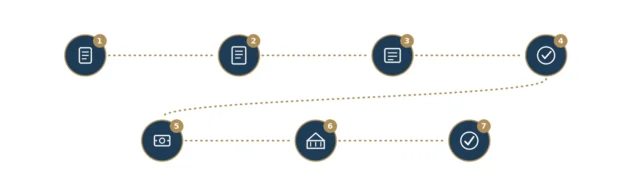
| # | Action | |
|---|---|---|
| 1 | Tax identification number | A Turkish tax ID is obtained for the foreign partners — a precondition for the rest of the process. |
| 2 | Document preparation | Passport, notarized translation, power of attorney where needed; for a foreign corporate partner, an apostilled certificate of activity and authorization documents. |
| 3 | Articles of association | The title, field of activity, capital, and ownership/management structure are drafted in compliance with the Turkish Commercial Code and entered into MERSİS. |
| 4 | MERSİS application and registration | The application is reviewed by the relevant Trade Registry Directorate; with complete documentation, the company acquires legal personality. |
| 5 | Foreign capital notification | Where required, notification is made through E-TUYS; partnership and capital movements are tracked. |
| 6 | Tax office, bank, and social security registration | Corporate tax liability is opened, a company bank account is opened, and, if there are employees, employer registration with the Social Security Institution is completed. |
| 7 | Commencement of operations | Once all formal procedures are complete, the company begins commercial activity. |
In our files at the Istanbul Trade Registries, registration takes 3–10 business days on average with a complete document package. This period can extend if foreign documents require re-authentication or if corrections are requested to the articles of association — which is why preparing the file correctly from the outset is the only real way to shorten it.
Do You Need to Be Physically Present in Turkey?
No. With an apostilled power of attorney, your Turkish lawyer can carry out the entire process on your behalf — from the MERSİS pre-registration to opening the bank account. In remote incorporations, we provide our clients with progress reports and instructions at every stage, in two languages (Turkish-English, and on request also Arabic, Russian, Persian, or Chinese); you always know clearly which document to sign and when.
Company Address: Physical Office or Virtual Office?
Every Turkish company must have a registered, valid Turkish address. This is not a mere formality: a wrongly chosen address can be rejected by the tax office, block the opening of a bank account, or become grounds for suspension at the trade registry.
- Leased physical office: requires registration of the lease agreement and the landlord’s consent.
- Virtual office: generally accepted for service-sector and holding structures, but must be obtained from a licensed provider and previously accepted by the relevant tax office.
- For sectors requiring physical inspection (retail, manufacturing, food, healthcare), a virtual office is generally not sufficient — a physical address inspection is required at the licensing stage.
This choice should be assessed against all four criteria at once — trade registry, tax office, bank KYC process, and, where applicable, sector-specific licensing inspection — not just one of them. Investors who skip this coordination often find themselves deciding to change address months after incorporation — which means a new registry fee, a new tax office notification, and weeks of delay.
Tax, Accounting, and Digital Compliance Obligations
From the moment your company is registered, tax and accounting obligations begin:
- Appointment of a certified public accountant (SMMM): mandatory and cannot be postponed; monthly VAT, withholding tax, quarterly advance tax, and annual corporate tax returns are carried out through this appointment.
- E-ledger and e-invoice: mandatory for companies exceeding a certain turnover or sector threshold; requires a financial seal / qualified electronic signature.
- Social Security Institution (SGK) employer registration: must be completed at the same time as incorporation if employment is planned.
- Foreign capital notifications: must be tracked through E-TUYS, especially with changes in ownership structure.
The large majority of foreign investors experience these obligations not as part of the incorporation process, but as a surprise afterward. Our approach is different: we plan the tax and accounting infrastructure together with the incorporation documents, at the same time.
Common Mistakes
Recurring mistakes we have seen over the years, which cost investors time and money:
- Choosing an entity type without comparing tax and governance implications
- Under-capitalizing relative to the planned activity
- An incomplete or expired apostille/translation chain for foreign documents
- Failing to deposit the capital within the legal timeframe
- Choosing an address the tax office will not accept
- Working with an accountant who does not meet the company’s actual reporting needs
- Overlooking a sector-specific licensing requirement before starting operations
None of these mistakes are complicated — all of them are preventable with the right legal advice from the very start of the process. The cost of not preventing them is usually weeks of delay and unforeseen additional expense.
Frequently Asked Questions
How long does incorporation take?
3–10 business days with a complete document package. Carefully preparing the documents in advance is the single biggest factor in shortening this time.
Is 100% foreign ownership possible?
Yes, in most sectors. A handful of regulated sectors — broadcasting, aviation, maritime — carry specific restrictions; you should check whether this applies to your planned activity.
Do I need to come to Turkey?
No. With an apostilled power of attorney, the entire process can be carried out remotely through your Turkish lawyer.
Can I use a virtual office?
Mostly yes, for service-sector activities; generally not sufficient for sectors requiring physical inspection (retail, manufacturing, food).
Can I open the bank account remotely?
In most cases, yes, with a valid power of attorney and complete KYC/AML documentation; some banks may request an in-person meeting depending on risk profile.
Which obligations continue after incorporation?
Accountant appointment and regular bookkeeping; monthly/quarterly/annual tax returns; the annual ordinary general assembly and registry notification; social security obligations if there are employees; activation of e-notification/e-ledger/e-invoice systems.
After Incorporating Your Company: What Comes Next?
Company incorporation is the first step of your investment journey — not the last. The typical sequence of needs we see in practice unfolds as follows:
- Company incorporation and setting up the tax/accounting infrastructure
- Work and residence permits for foreign nationals who will be present in Turkey as managers or employees
- Tax planning and corporate structuring as the business grows
- Supporting the investment with real estate (office, facility, or investment property)
- Considering Turkish citizenship at a certain investment threshold
- Long-term family and estate planning
Carrying out each of these steps with a single team that has known your investment from day one — rather than a different law firm for each — makes a real difference in time, consistency, and cost. This is what sets Tercan Legal apart: our 14 service areas are not independent of one another; they are stages of a single investor journey.
Why Tercan Legal?

| Founded in | Countries of Clients | Languages of Service | Country Partner Network |
|---|
We see company incorporation not merely as an official formality to complete, but as the secure beginning of your investment. Since 2006, we have served investors from over 70 countries, in 7 languages, through a partner network spanning 6 countries.
We have incorporated companies in Turkey for hundreds of clients from dozens of countries to date — from China to Russia, from Iran to Iraq, from the United States to the Gulf states. Each came from a different legal culture and different commercial habits — and for each, we adapted the process to their language, their document standards, and their investment goals. This experience means we have encountered, in advance, nearly every document type, every country-specific practice, and every foreign partnership structure that might come up.
- Whether you are setting up your first company in Turkey or planning a new investment, we listen to your needs, analyze your goals, and stand with you at every stage of the process.
- Our aim is not just to incorporate your company, but to build a solid legal foundation that lets you move forward confidently within the Turkish legal system.
- We act not only on fees, but on a vision of shared success.
Ready to Establish Your Company in Turkey?
Easisest way to register a company in Turkiye: Issue POA For Us
Opening Company in Turkiye is So Easy With Us
Contact us so we can manage your incorporation process with confidence, from the very first step.
www.tercanlegal.com/en/contact-career
The information in this note does not constitute legal advice on any matter and should not be treated as legal counsel. Please contact us to discuss our legal opinion on this subject.