
FREE ZONE COMPANY FORMATION IN TURKEY: THE COMPLETE 2026 LEGAL GUIDE FOR FOREIGN INVESTORS
ZONE-BY-ZONE GUIDE
Turkey’s 19 Free Zones Compared: Locations, Advantages and Key Sectors (2026 Guide)
By Tercan Legal — Istanbul company formation lawyers advising international investors in English, Arabic, Russian and Chinese.
Free zone company formation in Turkey remains one of the most efficient legal routes for export-oriented investors entering the Turkish market. A company licensed in one of Turkey’s 19 free zones operates inside Turkish territory but outside the Turkish customs territory, giving it customs duty relief, VAT exemptions, foreign-currency freedom and — for manufacturers — a corporate tax exemption on export income.
But the rules changed significantly on 1 January 2025, and much of what is published online is now out of date. This guide explains, in plain English, how the free zone regime actually works in 2026: the legal framework under Free Zones Law No. 3218, the tax reality after Law No. 7524, real costs and timelines, the two-track licensing and incorporation procedure, and how to choose the right zone.
Tercan Legal is an Istanbul law firm specialized in free zone company formation. Our lawyers work side by side with the firm’s dedicated tax and operations team, guiding foreign investors through every stage of free zone establishment — zone selection, the operating licence application, incorporation, lease negotiation, banking, work permits and ongoing compliance — with full legal service in English, Arabic, Russian and Chinese, as well as Persian and French. We have advised clients from more than 40 countries.
What Is a Free Zone (Serbest Bölge) in Turkey?
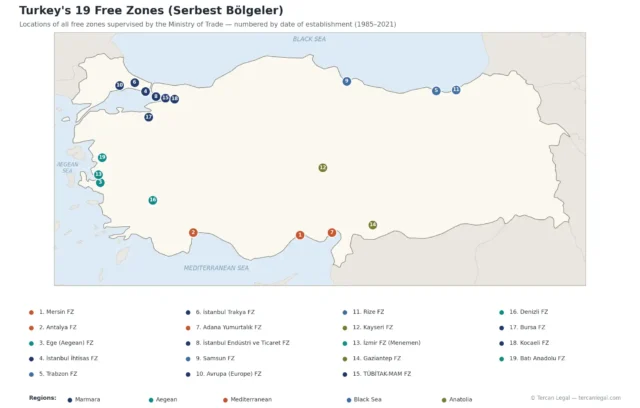
A free zone is a fenced, customs-supervised area designated by the government where a special regulatory and fiscal regime applies. Although the zone is physically inside Turkey, it is legally treated as outside the customs territory for customs, VAT and certain tax purposes. Turkey’s first zones (Mersin and Antalya) opened in 1985; today 19 free zones operate under the supervision of the Ministry of Trade’s General Directorate of Free Zones.
According to Ministry of Trade figures announced in 2024, more than 2,100 companies operate in Turkish free zones — around a quarter of them foreign-owned — employing roughly 100,000 people.
Permitted activities include manufacturing, general trading, warehousing and logistics, packing, assembly and disassembly, maintenance, R&D and software, and banking and insurance. Each company’s activity is defined by its operating licence (faaliyet ruhsatı).
Key Advantages of a Turkish Free Zone Company in 2026
| Advantage | What it means in practice |
|---|---|
| 100% foreign ownership | No local partner, no sponsor. Foreign individuals and companies enjoy national treatment under FDI Law No. 4875. |
| Customs duty exemption | Goods entering, stored and processed in the zone are outside the customs territory — no import duties while they remain there. |
| VAT exemption | Deliveries of goods and services into and within the zone are generally VAT-exempt. |
| Corporate tax exemption (export sales) | Manufacturers are exempt from corporate income tax on profits from goods produced in the zone and sold abroad (see the 2025 reform below). |
| Wage withholding exemption | Manufacturers exporting at least 85% of the FOB value of their zone production are exempt from income tax withholding on employee wages. |
| Stamp duty and fee relief | Documents and transactions relating to zone activities are exempt from stamp duty and various fees. |
| Foreign currency freedom | Companies may keep books, invoice and transact in convertible foreign currency — a natural hedge against lira volatility. |
| Free transfer of profits | Earnings may be transferred abroad or into Turkey without restriction. |
| Long-term operating rights | Licences run up to 15–20 years for tenant users and up to 30–45 years for investor users who build their own facilities. |
Why These Advantages Matter in Practice
Cash-flow relief at the border. Because the zone sits outside the customs territory, raw materials, machinery and trade goods enter without import duties or import VAT being paid up front. For a trading or manufacturing business, that is working capital that stays in the company instead of sitting with customs — goods can be stored in the zone without time limit and cleared only when and where they are actually sold.
A genuine tax shield on export income. A manufacturer producing in the zone and selling abroad pays no corporate income tax on that export profit, and if at least 85% of production (FOB) is exported, payroll income tax withholding disappears as well. On thin-margin export businesses, these two exemptions together often decide whether the Turkish operation is competitive at all.
Currency protection built into the structure. Free zone companies may invoice, contract, hold accounts and keep records in US dollars, euros or other convertible currencies. In an economy where lira volatility is a permanent planning factor, this is one of the most underrated advantages: your revenue, costs and books can live in the same hard currency as your international business.
Lower transaction friction. Stamp duty and fee exemptions on zone-related documents, VAT-free procurement of goods and services from mainland Turkey, simplified trade with third countries, and the free transfer of profits abroad all reduce the day-to-day cost of operating internationally from Turkey.
Predictability. The operating licence fixes your activity rights for 15–45 years, and Law No. 3218 guarantees that incentives valid on the licence date are preserved for its term — a level of regulatory certainty rare in emerging markets.
Tercan Legal specializes in free zone company formation. Our lawyers, together with our in-house tax and operations team, quantify each of these advantages against your actual trade figures before you spend a lira — in English, Arabic, Russian or Chinese.
The 2025 Tax Reform: What Changed (and What Most Guides Miss)
Two changes reshaped the economics of free zones — and any article that does not mention them is describing a regime that no longer exists:
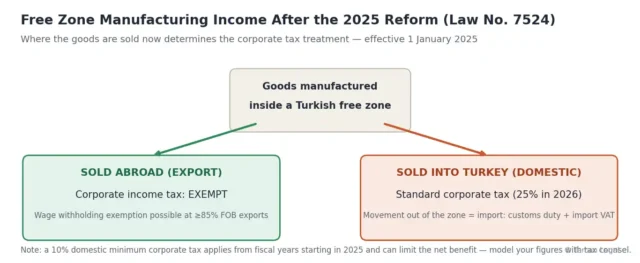
1. Export-only corporate tax exemption (Law No. 7524). Since 1 January 2025, the corporate income tax exemption on manufacturing income applies only to profits from goods sold abroad. Profits from selling zone-manufactured goods into the Turkish domestic market are taxed at the standard corporate rate (25% as of 2026). A free zone is no longer a vehicle for tax-free domestic sales.
2. Domestic minimum corporate tax. For fiscal years starting in 2025, Turkish corporate taxpayers are subject to a 10% domestic minimum corporate tax calculated before certain exemptions and deductions. This can limit the practical value of free zone exemptions in some structures and must be modelled case by case with a tax adviser.
Two further points investors regularly misunderstand:
- Goods leaving the zone for Turkey are imports. Customs duties and import VAT apply, exactly as for any import into Turkey.
- The wage incentive is withholding relief only. Employer social security (SGK) premiums remain payable in full, the 85% FOB export threshold is assessed annually, and certification by a sworn financial adviser (YMM) is normally required.
Tercan Legal works with partner tax and SGK advisors as a single, end-to-end team, so your legal structure and tax model are built together — not by two offices that never speak. Advice is available in English, Arabic, Russian and Chinese.
Free Zone vs Mainland Company vs Technopark: Which Structure Fits?
| Factor | Free zone company | Mainland company | Technopark company |
|---|---|---|---|
| Best for | Export manufacturing, re-export trade, logistics | Sales mainly inside Turkey | Software, R&D, design income |
| Legal basis | Law No. 3218 + TCC 6102 | TCC 6102 | Law No. 4691 + TCC 6102 |
| Corporate tax | Exempt on export manufacturing profits; standard rate on domestic sales | Standard rate (25%) | Exempt on qualifying software/R&D income until 31.12.2028 |
| Customs / VAT | Zone outside customs territory; VAT-free in-zone deliveries | Standard rules | VAT exemption on in-zone software deliveries |
| Physical presence | Licensed premises in the zone required | Flexible (virtual office possible) | Admitted premises in the technopark required |
| Entry barrier | Operating licence + lease | Trade registry only | Project evaluation by zone management |
Free Zone vs Mainland Turkey: The Detailed Comparison
| Criterion | Free zone company | Standard (mainland) company |
|---|---|---|
| Incorporation | TCC 6102 company + operating licence from the Ministry of Trade | TCC 6102 company; trade registry only |
| Foreign ownership | 100% permitted | 100% permitted |
| Corporate tax | Exempt on export manufacturing profits; 25% on domestic sales; 10% minimum tax may apply | 25% on all profits (10% minimum tax may apply) |
| VAT | In-zone deliveries and purchases from Turkey generally VAT-exempt | 1–20% VAT on domestic transactions; export refund mechanism |
| Customs duties | None while goods remain in the zone; unlimited storage | Paid at import; bonded warehouse needed for deferral |
| Payroll | Income tax withholding exemption at ≥85% FOB exports (SGK still due) | Full income tax withholding + SGK |
| Stamp duty & fees | Exempt for zone-related documents | Payable |
| Accounting currency | Convertible foreign currency permitted | Turkish lira books (with limited exceptions) |
| Premises | Physical presence in the zone mandatory; lease from zone operator | Free choice anywhere in Turkey; virtual office possible |
| Entry cost & time | Licence fee (USD 5,000+), zone rents, per-mille levy; 1–2 months | Registry fees only; about 1–2 weeks |
| Selling into Turkey | Treated as import: customs duty + import VAT + standard corporate tax | Ordinary domestic sale |
| Ongoing compliance | Activity reports, export-ratio monitoring, zone inspections, licence renewal | Standard tax and commercial filings |
| Ideal profile | Export manufacturer, re-export trader, international logistics | Business whose customers are mainly inside Turkey |
The honest verdict: a free zone is not “better” than the mainland — it is better for a specific profile. If your inputs are imported and your customers are abroad, the zone converts customs, VAT, corporate tax and payroll relief into real margin, and the extra setup cost pays for itself quickly. If your market is Turkey, the mainland is cheaper, faster and — since the 2025 reform — carries essentially the same tax result on those domestic sales. As free zone formation specialists, Tercan Legal runs this break-even analysis for every client with our tax and operations team before recommending either route.
Rule of thumb: if most of your customers are outside Turkey and physical goods (or an export-heavy operation) are involved, a free zone usually pays off. If your customers are inside Turkey, a mainland company is simpler — and since 2025, often no worse on tax. If you sell software or R&D output, compare the technopark route first. Tercan Legal models all three structures against your actual figures before you commit to any of them.
Legal Structures Available in a Free Zone
A free zone company is an ordinary Turkish company incorporated under the Turkish Commercial Code No. 6102, with the free zone regime layered on top. The usual options:
- Limited liability company (limited şirket) — minimum capital TRY 50,000, one shareholder and one director suffice; the standard choice for SMEs.
- Joint stock company (anonim şirket) — minimum capital TRY 250,000; preferred for larger investments, multiple investors or future capital raising.
- Branch of an existing Turkish or foreign company — operates in the zone without a new legal entity.
There is no nationality requirement for shareholders or directors, and the entire incorporation can be handled remotely through a notarized and apostilled power of attorney — Tercan Legal routinely completes free zone formations for clients who never leave their home country until the bank account stage.
Step-by-Step: How to Establish a Free Zone Company in Turkey
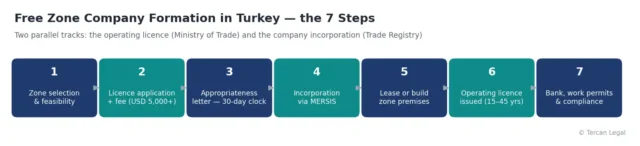
Free zone establishment runs on two parallel tracks: the operating licence and the company incorporation.
- Zone selection and feasibility. Match your activity, target markets, logistics and premises needs to the right zone (see our full guide to Turkey’s 19 free zones). Confirm current facility availability with the zone operator before committing.
- Business plan and application. Complete the Operating Licence Application Form and project file — activity description, trade volume and export projections, financials — and pay the application fee (USD 5,000 as a baseline; higher amounts apply to certain activities and licence terms) to the relevant free zone account.
- Evaluation and appropriateness letter. The General Directorate of Free Zones evaluates the application. If approved, an “appropriateness letter” is issued — and a 30-day clock starts: the company must be incorporated and the zone lease (or land purchase for investor users) executed and approved within that window, or the application lapses and the fee is forfeited.
- Incorporation. Articles of association are filed through MERSIS, documents are notarized (foreign documents apostilled and translated), and the company is registered with the trade registry. Tax number and SGK registration follow.
- Lease or build premises. Tenant users lease existing units; investor users acquire land and build. A genuine physical presence is mandatory — “paper” registrations are not accepted.
- Operating licence issued. Tenant users: 20 years (production) / 15 years (other activities). Investor users: 45 years (production) / 30 years (other activities).
- Operational setup. Corporate bank account (multi-currency), customs procedures, employment contracts, work permits for foreign staff, and the compliance calendar.
Typical timeline: 2–6 weeks for incorporation-related steps; allow 1–2 months overall including licence evaluation. Documentation quality is the single biggest driver of speed.
What It Costs
- Operating licence application fee — USD 5,000 baseline; varies by activity type and licence period.
- Annual licence and premises fees — payable to the zone operator; vary widely by zone and unit type.
- Special Account levy — a per-mille (binde) levy on goods traded through the zone, charged on CIF value entering and FOB value leaving; rates and exemptions are set by regulation.
- Share capital — TRY 50,000 (limited şirket) or TRY 250,000 (anonim şirket).
- Professional costs — legal fees, notarization/apostille/sworn translation, accounting, and YMM certification if you claim the wage incentive.
Free zone setup costs more upfront than a mainland company; the question is whether your export volume converts the exemptions into savings that exceed those costs. That is a spreadsheet question, and we build the spreadsheet with you.
Ongoing Compliance: Keeping the Benefits You Signed Up For
Free zone advantages are conditional, not automatic. Companies must operate strictly within the licensed activity scope, file periodic activity reports with the Free Zone Directorate, maintain the export ratios underpinning their exemptions, keep books to Turkish standards, and renew the licence on time. The zone authority inspects regularly; falling below the 85% export threshold in a given year costs that year’s wage exemption, and repeated non-compliance can put the licence itself at risk.
Tercan Legal maintains compliance calendars for its free zone clients and represents them before zone directorates, tax offices and customs — in your language, with Turkish-language filings handled by us.
Work Permits, Residence and the Founder’s Family
Foreign shareholders who will actively manage the company from Turkey need a work permit under Law No. 6735 (a director residing abroad does not). Work permit applications by zone-licensed companies are generally processed smoothly, and permits for the founder open the door to residence for spouses and children. Where the investor’s broader plan includes Turkish citizenship by investment, we structure the company and the investment so the two tracks reinforce each other — a free zone company alone does not confer citizenship, but the surrounding investment strategy can be designed to qualify.
Common Mistakes We See (and Prevent)
- Choosing a zone by name recognition instead of logistics, sector fit and current vacancy.
- Relying on pre-2025 articles and budgeting for a “tax-free” company that no longer exists.
- Missing the 30-day incorporation-and-lease deadline after the appropriateness letter.
- Drafting an activity scope that is too narrow (blocks growth) or too broad (fails evaluation).
- Treating domestic sales from the zone as ordinary sales rather than imports into Turkey.
- Forgetting that SGK premiums remain payable despite the wage withholding exemption.
- Signing the zone lease without negotiating early-termination and improvement clauses.
Why Tercan Legal for Your Free Zone Company
Tercan Legal is an Istanbul law firm built for international clients, with free zone company formation as a core specialization. Our company formation team has advised founders and corporates from 40+ countries. Crucially, we are not lawyers working alone: the firm operates with a dedicated tax and operations team — tax/SGK advisors, academician-level counsel and partner offices — so licensing, incorporation, tax modelling, payroll, customs operations and immigration are handled under one roof, as a single package with a single point of contact.
- Languages: full legal service in English, Arabic, Russian and Chinese, plus Turkish, Persian/Farsi and French.
- Scope: zone selection, licence applications, incorporation, lease negotiation, banking, customs, work permits, compliance and disputes.
- Format: remote formation by power of attorney, fixed-fee proposals, and a single point of contact who speaks your language.
Contact Tercan Legal
Office
Hikaye Sokak No 7, Office: 6, 34394 Esentepe, Şişli – Istanbul, Türkiye
FAQ — Free Zone Company Formation in Turkey
Can a foreigner own 100% of a Turkish free zone company?
Yes. There is no local partner requirement. Foreign individuals and companies enjoy national treatment under FDI Law No. 4875, and the company is incorporated under the Turkish Commercial Code No. 6102.
Is a Turkish free zone company tax-free?
No. Since 1 January 2025 the corporate tax exemption on manufacturing income covers only export sales; domestic sales are taxed at the standard rate, and a 10% domestic minimum corporate tax applies. Customs and VAT relief inside the zone remain in force.
How long does free zone company formation take?
Typically 2–6 weeks for the incorporation track and 1–2 months overall including operating licence evaluation, assuming complete documentation.
How much does it cost to set up in a Turkish free zone?
Budget for the operating licence application fee (USD 5,000 baseline), annual zone and premises fees, the per-mille Special Account levy on traded goods, share capital (TRY 50,000+), and professional costs. Figures change by regulation — verify current numbers for your zone.
Do I need a physical office or warehouse in the zone?
Yes. A lease (or owned facility for investor users) inside the zone is a condition of the operating licence. Virtual-only registration is not accepted.
Can I complete the process without travelling to Turkey?
Almost entirely. With a notarized, apostilled power of attorney we handle the tax number, licence application, incorporation and registrations remotely. Most banks still require the director to appear once for account opening.
Can a free zone company sell into the Turkish market?
Yes, but goods moving from the zone into Turkey are treated as imports: customs duties and import VAT apply, and since 2025 the related profit is taxable at the standard corporate rate.
Which free zone should I choose?
It depends on your sector, logistics and target markets — see our companion guide to all 19 Turkish free zones, or ask us for a comparative zone assessment in your language.
Do foreign employees in a free zone need work permits?
Yes. Free zone employment follows Turkish labor law, and foreign staff need work permits under Law No. 6735, though processing for zone-licensed companies is comparatively streamlined.
Does Tercan Legal handle the entire process?
Yes — zone selection, licence application, incorporation, lease, banking, tax and SGK setup, work permits and ongoing compliance, with service in English, Arabic, Russian, Chinese and other languages.
Legal Disclaimer: This guide is provided for general information purposes only and does not constitute legal advice. Turkish legislation, thresholds and official fees change frequently; figures cited reflect the position at the date of publication and should be verified for your specific transaction. No attorney–client relationship is created by reading this material. For advice on your particular situation, please contact Tercan Legal directly. © 2026 Tercan Legal. All rights reserved.