
FREE ZONE COMPANY FORMATION IN TURKEY: THE COMPLETE 2026 LEGAL GUIDE
ZONE-BY-ZONE GUIDE
Turkey’s 19 Free Zones Compared: Locations, Advantages and Key Sectors (2026 Guide)
By Tercan Legal — company formation lawyers in Istanbul advising free zone investors in English, Arabic, Russian and Chinese.
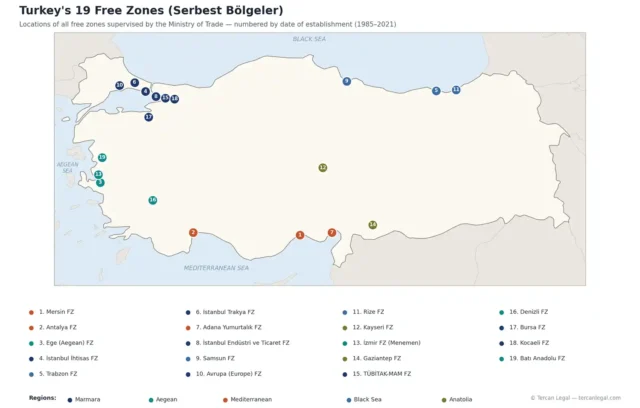
Turkey operates 19 free zones, stretching from the Bulgarian border to the Georgian coast and from the Aegean to the Syrian frontier. They are not interchangeable: each zone has its own geography, port and road connections, sectoral ecosystem, operator company, rent levels and vacancy situation. Choosing the right one is the single most consequential decision in free zone company formation — it locks in your logistics costs, your supplier network and often your licence conditions for 15–45 years.
This guide profiles every zone: where it is, what it is good at, and which investors it suits. For the legal and tax framework — Law No. 3218, the 2025 tax reform, licence procedure and costs — see our companion guide, Free Zone Company Formation in Turkey: The Complete 2026 Legal Guide.
How we help: Free zone company formation is a core specialization at Tercan Legal. Our lawyers and our in-house tax and operations team prepare comparative zone assessments, negotiate with zone operators and handle the entire licence-and-incorporation process — with full legal service in English, Arabic, Russian and Chinese. Wherever your zone is, your lawyer speaks your language.
All 19 Turkish Free Zones at a Glance
| # | Free zone | Est. | Location | Signature sectors |
|---|---|---|---|---|
| 1 | Mersin | 1985 | Mersin port, Mediterranean | Trade, logistics, re-export to MENA & Gulf |
| 2 | Antalya | 1985 | Antalya, Mediterranean | Yacht building, marine, manufacturing, software |
| 3 | Ege (Aegean) | 1987 | İzmir – Gaziemir | Export manufacturing, electronics, aviation, R&D |
| 4 | İstanbul İhtisas | 1990 | İstanbul – Atatürk Airport | High-value trade, jewelry, IT, aviation-linked |
| 5 | Trabzon | 1990 | Trabzon port, Black Sea | Trade with Caucasus, Russia, Iran corridor |
| 6 | İstanbul Trakya | 1990 | İstanbul – Çatalca | Manufacturing, textiles, trade, warehousing |
| 7 | Adana Yumurtalık | 1992 | İskenderun Bay | Heavy industry, energy, steel, petrochemicals |
| 8 | İstanbul Endüstri ve Ticaret | 1992 | İstanbul – Tuzla | Leather, textiles, light manufacturing, trade |
| 9 | Samsun | 1995 | Samsun port, Black Sea | Black Sea basin trade, agri products |
| 10 | Avrupa (Europe) | 1996 | Tekirdağ – Çorlu | Industrial manufacturing, textiles, machinery |
| 11 | Rize | 1997 | Rize port, Eastern Black Sea | Regional trade toward the Caucasus |
| 12 | Kayseri | 1997 | Kayseri, Central Anatolia | Furniture, metal goods, cables |
| 13 | İzmir | 1997 | İzmir – Menemen | Leather and footwear |
| 14 | Gaziantep | 1998 | Gaziantep, Southeast | Carpets, textiles, food, Middle East trade |
| 15 | TÜBİTAK-MAM | 1999 | Kocaeli – Gebze | Technology, R&D, informatics |
| 16 | Denizli | 2000 | Denizli, Aegean hinterland | Home textiles, marble, cables |
| 17 | Bursa | 2000 | Bursa | Automotive and components, machinery |
| 18 | Kocaeli | 2000 | İzmit Bay | Port industry, shipbuilding, chemicals, logistics |
| 19 | Batı Anadolu | 2021 | İzmir – Bergama | Renewables, high-tech manufacturing, auto supply |
Istanbul and Marmara Region Free Zones
Istanbul and the surrounding Marmara industrial belt host the densest cluster of zones — the natural choice for investors who need Turkey’s largest business ecosystem, two international airports and proximity to the country’s manufacturing heartland. Tercan Legal is based in Istanbul (Esentepe), minutes from these zones, and serves their international users in English, Arabic, Russian and Chinese.
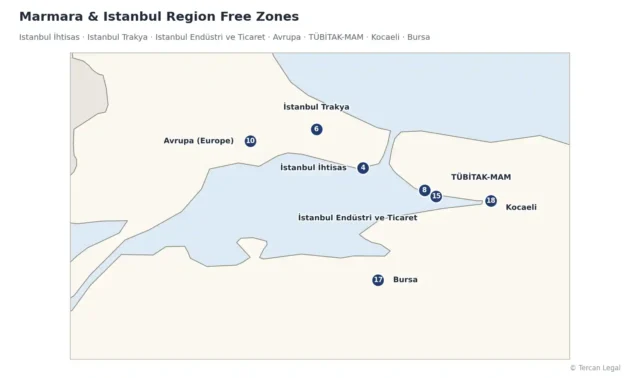
Istanbul free zone company formation — Marmara region free zones map
1. İstanbul İhtisas (Specialized) Free Zone — est. 1990
Location: Yeşilköy, on the grounds of Atatürk Airport, European side of Istanbul. Advantages: Unmatched air-cargo proximity for high-value, low-weight goods; a dense trading ecosystem; immediate access to Istanbul’s banks, customs brokers and service providers. Sectors: high-value trading, jewelry and precious metals, IT and software, aviation-related services. Best for: traders in high-value goods and service exporters who need to be inside Istanbul.
2. İstanbul Trakya (Thrace) Free Zone — est. 1990
Location: Çatalca, on Istanbul’s European side, on the road corridor to the Bulgarian and Greek border gates. Advantages: Large industrial plots at lower cost than central Istanbul; straightforward trucking to EU markets; room for warehousing at scale. Sectors: manufacturing, textiles and apparel, general trade, logistics and distribution. Best for: manufacturers and distributors serving European customers by road.
3. İstanbul Endüstri ve Ticaret (Industry & Trade) Free Zone — est. 1992
Location: Tuzla, on Istanbul’s Anatolian side, operated by DESBAŞ; close to Sabiha Gökçen Airport and the Tuzla industrial basin. Historically known as the Istanbul Leather Free Zone. Advantages: Established multi-sector ecosystem, strong operator services, proximity to Anatolian-side industry and the E-80 corridor. Sectors: leather and leather goods, textiles, chemicals, light manufacturing, general trading. Best for: SMEs wanting an Istanbul address with industrial flexibility. Many of the zone’s users are foreign-owned — our Russian-, Arabic- and Chinese-speaking lawyers regularly act for investors here.
4. Avrupa (Europe) Free Zone — est. 1996
Location: Çorlu, Tekirdağ — the Thrace industrial corridor west of Istanbul. Advantages: One of Turkey’s most manufacturing-weighted zones; competitive land and labor costs; quick road access to both Istanbul and the EU border. Sectors: industrial manufacturing, textiles, machinery, plastics, aviation-linked production. Best for: production-focused investors who want Marmara logistics without Istanbul rents.
5. TÜBİTAK-MAM Technology Free Zone — est. 1999
Location: Gebze, Kocaeli, inside the TÜBİTAK Marmara Research Center campus. Advantages: Turkey’s only research-anchored free zone — direct synergy with national research institutes, laboratories and a qualified engineering workforce, midway between Istanbul and the Kocaeli industrial basin. Sectors: software and informatics, electronics, biotechnology, advanced materials, R&D services. Best for: technology companies weighing the free zone route against a technopark; we model both regimes side by side before you choose.
6. Kocaeli Free Zone — est. 2000
Location: İzmit Bay, in Turkey’s densest industrial province, with its own port access. Advantages: Deep-water access inside the Marmara industrial heartland; heavy-cargo capability; a supplier base of thousands of industrial firms within an hour. Sectors: shipbuilding and ship repair, steel and metal processing, chemicals, project cargo and logistics. Best for: heavy industry and maritime-linked investors.
7. Bursa Free Zone — est. 2000
Location: Bursa, on the Gemlik Bay axis, in the capital of Turkey’s automotive industry. Advantages: Immediate access to Turkey’s automotive OEM and supplier ecosystem; Gemlik port nearby; skilled industrial workforce. Sectors: automotive components, machinery, textiles technology, engineering plastics. Best for: automotive and machinery suppliers integrating into European supply chains.
Aegean Region Free Zones
The Aegean cluster around İzmir combines Turkey’s most successful manufacturing free zone with specialized and next-generation sites. Tercan Legal represents Aegean-zone investors remotely from Istanbul — with documents, negotiations and filings handled in your language, whether that is English, Arabic, Russian or Chinese.
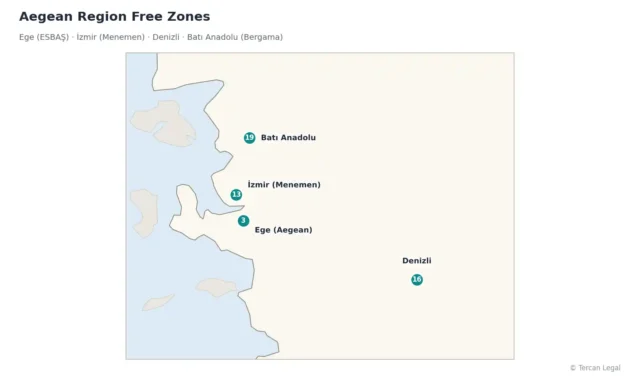
Aegean free zones Turkey — Ege ESBAŞ, İzmir, Denizli and Batı Anadolu map
8. Ege (Aegean) Free Zone — est. 1987
Location: Gaziemir, İzmir, operated by ESBAŞ; minutes from Adnan Menderes Airport and İzmir’s ports. Advantages: Turkey’s flagship free zone and its largest free zone employer — a mature, professionally managed ecosystem with ready industrial buildings, an on-site workforce pipeline and decades of foreign-investor track record. Sectors: electronics, aerospace and aviation components, machinery, medical devices, apparel, R&D. Best for: serious export manufacturers, including US and EU corporates establishing a Turkish production base.
9. İzmir Free Zone — est. 1997
Location: Menemen, north of İzmir. Advantages: A specialized, cost-effective site with an established identity in leather processing. Sectors: leather, footwear, related textiles. Best for: leather and footwear producers exporting to Europe and the Middle East.
10. Denizli Free Zone — est. 2000
Location: Denizli, the Aegean hinterland’s textile capital. Advantages: Sits inside one of the world’s best-known home-textile clusters; deep local supplier and subcontractor network. Sectors: home textiles (towels, bathrobes, bed linen), cables, natural stone and travertine. Best for: textile and stone exporters sourcing from the Denizli cluster.
11. Batı Anadolu Free Zone (BASBAŞ) — est. 2021
Location: Bergama, İzmir — Turkey’s newest free zone, about 20 km from the planned Çandarlı North Aegean Port, with port access today via Aliağa/Nemrut Bay. Advantages: Modern, purpose-built 2.5 million m² site with land and build-to-suit options that older, fuller zones can no longer offer; motorway link to Europe via the 1915 Çanakkale Bridge (İpsala border in ~4.5 hours); priority given to renewable energy and high-technology investments. Sectors: renewable energy equipment, high-tech manufacturing, automotive supply, racking and warehouse systems, industrial insulation, cosmetics. Best for: greenfield manufacturers who need large plots and a long runway. Early movers here have included American and European corporates — our English-speaking corporate team handles exactly these entries.
Mediterranean Region Free Zones
The Mediterranean zones are Turkey’s gateways to the Middle East, the Gulf and North Africa — and the natural home for our Arabic-speaking clients. Tercan Legal’s Arabic-language desk manages the full formation process for investors from the Gulf, the Levant and North Africa, alongside our English, Russian and Chinese desks.
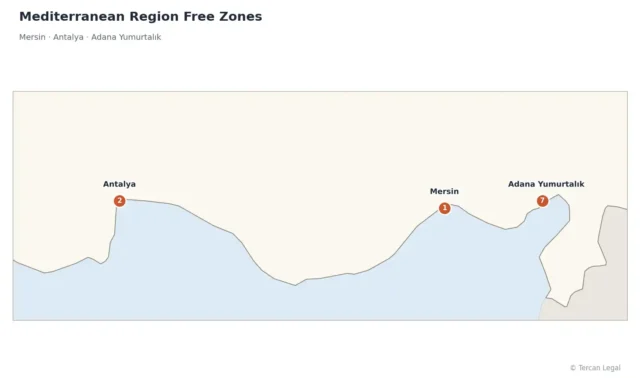
Mediterranean free zones Turkey — Mersin, Antalya and Adana Yumurtalık map
12. Mersin Free Zone — est. 1985
Location: Adjacent to Mersin International Port, Turkey’s principal Mediterranean container hub. Advantages: Turkey’s first and one of its busiest free zones; direct berth-side logistics; shipping lines to the entire Eastern Mediterranean; a mature trading community accustomed to re-export. Sectors: general trade, storage and transit, re-export to the Middle East, Gulf, North Africa and Central Asia, food and commodities, machinery. Best for: trading and logistics companies using Turkey as a regional distribution hub.
13. Antalya Free Zone — est. 1985
Location: West of Antalya, with its own pier on the Mediterranean. Advantages: A unique marine-industry cluster inside a global tourism hub; direct sea access for oversized cargo; strong quality-of-life pull for foreign managers and their families. Sectors: yacht and boat building (one of the world’s notable clusters), marine equipment, manufacturing, software and services. Best for: marine industry investors and lifestyle-driven founders — many of them Russian-speaking; our Russian desk serves this community end to end.
14. Adana Yumurtalık Free Zone — est. 1992
Location: Yumurtalık on İskenderun Bay (TAYSEB), in Turkey’s energy and heavy-industry corridor near Ceyhan. Advantages: Vast plots zoned for heavy industry; deep-water access; adjacency to pipelines, refineries and steel capacity. Sectors: energy, petrochemicals, iron and steel, heavy manufacturing, project logistics. Best for: capital-intensive industrial and energy projects.
Black Sea Region Free Zones
The Black Sea zones face Russia, Ukraine, Georgia and the Caucasus — markets where our Russian-speaking lawyers give clients a decisive practical advantage, from negotiating with counterparties to translating the entire licence file.
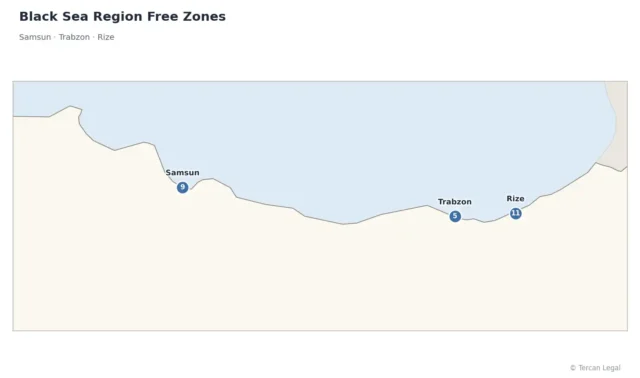
Black Sea free zones Turkey — Samsun, Trabzon and Rize map
15. Trabzon Free Zone — est. 1990
Location: Trabzon port, Eastern Black Sea. Advantages: The historic gateway for trade with Georgia, Azerbaijan, southern Russia and northern Iran; ro-ro and general cargo connections; land corridor to the Caucasus. Sectors: regional trade, logistics, foodstuffs, construction materials. Best for: traders serving the Caucasus–Caspian corridor.
16. Samsun Free Zone — est. 1995
Location: Samsun port, central Black Sea coast. Advantages: The Black Sea’s central Turkish hub with rail, road and port intermodality; direct lines across the Black Sea basin. Sectors: Black Sea basin trade, agricultural products and processing, machinery. Best for: agri-trade and companies routing goods between Anatolia and Black Sea markets.
17. Rize Free Zone — est. 1997
Location: Rize port, Eastern Black Sea. Advantages: Compact, low-cost base close to the Georgian border (Sarp gate). Sectors: regional trade and storage toward the Caucasus. Best for: smaller trading operations focused on Georgia and the Caucasus.
Central and Southeastern Anatolia Free Zones
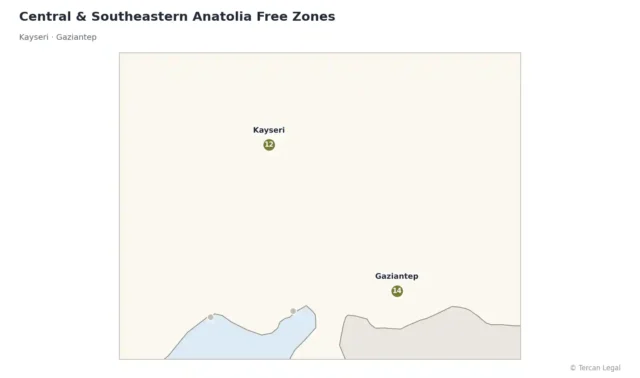
Central and Southeastern Anatolia free zones — Kayseri and Gaziantep map
18. Kayseri Free Zone — est. 1997
Location: Kayseri, Central Anatolia’s manufacturing powerhouse, at the junction of national road and rail corridors. Advantages: Inside one of Turkey’s strongest Anatolian industrial cities; competitive labor; a deep furniture-and-metal supplier base. Sectors: furniture, metal products, cables and electrical equipment, textiles. Best for: manufacturers exporting from a low-cost inland base.
19. Gaziantep Free Zone — est. 1998
Location: Gaziantep, Turkey’s southeastern industrial capital, on the trade routes to Iraq, Syria and the wider Middle East. Advantages: One of the world’s leading machine-made carpet clusters at its doorstep; centuries-old trading culture; direct road access to Middle Eastern markets. Sectors: machine-made carpets, textiles, food processing, packaging, Middle East trade. Best for: manufacturers and traders targeting Iraq, the Gulf and MENA. Gaziantep’s business community works largely in Arabic — as does our Arabic-language legal team, which handles these files natively.
How to Choose Between the 19 Zones
- Follow your cargo, not the brochure. Distance to your port, border gate or airport dominates lifetime costs.
- Match the sector ecosystem. A carpet exporter belongs near Gaziantep’s cluster; an auto supplier near Bursa’s; an aerospace shop in the Aegean.
- Check real vacancy and rents now. Several mature zones are effectively full; newer sites like Batı Anadolu still offer land.
- Model the tax outcome under the 2025 rules. Export ratio decides whether the exemptions are worth the zone’s costs.
- Read the operator’s lease like the contract it is. Terms differ meaningfully between operators — we negotiate them for you.
Tercan Legal prepares side-by-side zone comparisons tailored to your business plan, then executes the winning option end to end. Every step — from the feasibility file to the operating licence — is explained to you in English, Arabic, Russian or Chinese, with all Turkish filings handled by our Istanbul team.
FAQ — Turkey’s Free Zones
How many free zones are there in Turkey?
Nineteen, established between 1985 (Mersin, Antalya) and 2021 (Batı Anadolu), all supervised by the Ministry of Trade.
Which is the biggest free zone in Turkey?
By employment and manufacturing depth, the Ege (Aegean) Free Zone in İzmir is the flagship; Mersin leads in port-based trade volume.
Which free zone is best for trade with the Middle East?
Mersin for sea trade and regional distribution; Gaziantep for road trade with Iraq and the Levant. Our Arabic-speaking lawyers support both.
Which free zone suits technology companies?
TÜBİTAK-MAM in Gebze is the research-anchored option; for pure software income, compare the technopark regime before choosing a free zone.
Is there a free zone with land still available for large factories?
Batı Anadolu (Bergama, İzmir), opened in 2021, was created precisely because older zones filled up; it offers large plots and build-to-suit options.
Can Tercan Legal handle a free zone formation outside Istanbul?
Yes — free zone formation is our specialty. We act nationwide by power of attorney, travel to zone directorates when needed, and support the company after formation through our tax and operations team, serving clients in English, Arabic, Russian, Chinese and other languages.
Contact Tercan Legal
Office
Hikaye Sokak No: 7, Floor: 2, 34394 Esentepe, Istanbul
Legal Disclaimer: This guide is provided for general information purposes only and does not constitute legal advice. Turkish legislation, thresholds and official fees change frequently; figures cited reflect the position at the date of publication and should be verified for your specific transaction. No attorney–client relationship is created by reading this material. For advice on your particular situation, please contact Tercan Legal directly. © 2026 Tercan Legal. All rights reserved.