
Investing in Türkiye: Steps, Documents and Costs (2026 Guide)
Tercan Legal — Turkish corporate lawyers for foreign investors, Istanbul, since 2013
Author: Av. Mithat Tercan · Istanbul Bar Association, Reg. No. 45421 · Verify at the official Bar roster: istanbulbarosu.org.tr/levha
This page tells you exactly what each type of investment in Türkiye requires: the steps, the documents, the costs, the timelines. No theory. Tercan Legal has handled these files for hundreds of foreign investors from 40+ countries since 2013, and almost all of it can be done without you coming to Türkiye — a power of attorney is enough. How that works is at the end of this page.
The One Document That Runs Everything: Power of Attorney
Before the individual processes — understand this, because it changes your planning. Company registration, buying property, opening bank accounts, signing at the notary, applying for citizenship: your lawyer can do all of it for you under a power of attorney (POA). You have two ways to issue one:
- At a Turkish consulate in your country — issued directly in Turkish, ready to use.
- At a local notary in your country — then apostilled and translated by a sworn translator in Türkiye.
Two practical rules: a POA for buying real estate must contain your photograph, or the land registry will reject it. And the POA must list the specific powers (purchase, company establishment, bank account opening, citizenship application) — a generic text is not enough. We send every client a ready-made POA text; you take it to the consulate, and that is usually your only task in the entire process.
1. Company Establishment in Turkey (Registration & Opening)
Company setup in Turkey is fast when the file is prepared correctly. 100% foreign ownership is allowed. You choose between a limited company (Ltd. Şti.) — minimum capital TRY 50,000 — and a joint stock company (A.Ş.) — minimum capital TRY 250,000, with 25% of cash capital blocked before registration. Short version: Ltd. is fine for small operations; choose A.Ş. if you will bring in partners, raise money or sell one day, and because A.Ş. shareholders are not personally chased for company tax and social security debts.
The process, step by step
- You send us your passport copy and sign the POA at a Turkish consulate.
- We obtain your Turkish tax number (same day, online).
- We draft the articles of association and reserve the trade name.
- Registration through MERSİS and the Trade Registry — the company exists in 3–7 business days once documents are complete.
- Tax office registration, signature circular, statutory books.
- Corporate bank account opening — in practice the slowest step; plan around the bank, not the registry.
- If you will work in the company yourself: work permit application through the e-İzin system.
📋 Documents — foreign individual shareholder
☐ Power of attorney (photo not required for company POA)
☐ Turkish tax number (we obtain it for you)
☐ Registered office address in Türkiye (we can provide at start-up)
☐ Proposed trade name and field of activity
📋 Additional documents — foreign corporate shareholder
☐ Board resolution on establishing the Turkish company (apostilled)
☐ Signature authority documents of the signing officers (apostilled)
☐ All with sworn Turkish translations
2. Buying an Existing Turkish Company (Share Purchase)
In a Turkish share deal, the company’s past comes with the shares — unpaid tax, social security (SGK) debts, pending lawsuits, all of it. The process protects you only if it runs in this order:
- NDA and letter of intent — lock the price logic and exclusivity before spending money.
- Due diligence — we review corporate records, tax, SGK, litigation, licences, real estate, key contracts (change-of-control clauses hide in bank and supplier agreements).
- Share purchase agreement — price mechanism, warranties, indemnities, and an escrow/holdback so the seller’s promises have money behind them.
- Regulatory clearances — Competition Board approval above turnover thresholds (fee: 0.04% of transaction value); sector approvals for banking, energy, insurance.
- Closing — notarised transfer + share ledger for Ltd. Şti.; endorsement + board approval for A.Ş. shares; trade registry filing.
📋 What we ask the seller for
☐ Last 3–5 years of tax returns and SGK statements
☐ Litigation list and enforcement file search
☐ Licence and permit inventory
☐ Title deeds and lease agreements
☐ Top-10 customer and supplier contracts
3. Joint Ventures with Turkish Partners
Standard structure: a jointly-owned A.Ş. + a shareholders’ agreement. The articles of association are public and generic; the shareholders’ agreement is where you are actually protected. Non-negotiables to put in it:
- Board seats and reserved matters — the decisions that cannot pass without your vote (capital increase, borrowing, related-party deals);
- Deadlock mechanism — what happens when 50/50 stops agreeing;
- Exit rights — put/call options, drag-along, tag-along;
- Non-compete and confidentiality;
- Dispute clause — arbitration seat and language decided now, not during the fight.
Every JV dispute we litigate has the same origin: the foreign partner signed the Turkish side’s standard articles and never asked for a shareholders’ agreement.
4. Franchising in Türkiye
No dedicated franchise statute exists — your contract is the entire framework. The practical checklist:
- Register your trademark in Türkiye before signing anything. Not after.
- Choose the structure: master franchise (one partner develops the country) vs unit franchises (you keep control, more management).
- Fix royalty flows and withholding tax — treaty relief must be structured in advance.
- Territory, term, renewal, termination and post-term non-compete — drafted for Turkish enforceability, not copied from your home template.
- Dispute clause: Istanbul arbitration is enforceable and practical; foreign court clauses often are not.
5. Real Estate & Turkish Citizenship by Investment
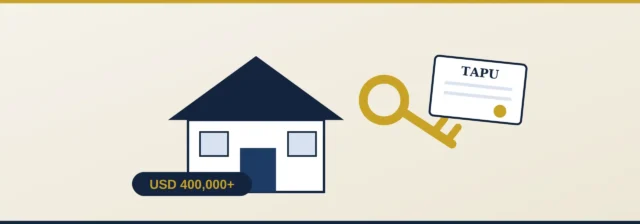
Citizens of most countries can buy property in Türkiye in their own name. A purchase of USD 400,000 or more (official valuation), with a 3-year non-sale annotation, qualifies you, your spouse and children under 18 for Turkish citizenship by investment. Alternatives: USD 500,000 bank deposit or USD 500,000 in government bonds/funds, each held 3 years.
Purchase + citizenship, step by step
- POA (with your photo) signed at a Turkish consulate; we obtain your tax number.
- We run the title deed (tapu) and encumbrance check — mortgages, liens, zoning, building compliance. Deposit is paid only after this.
- SPK-licensed valuation report confirming the USD 400,000 threshold.
- Purchase price transferred through a Turkish bank with a foreign currency purchase document (DAB) — mandatory for citizenship files.
- Title transfer at the land registry with the 3-year non-sale annotation.
- Certificate of conformity (Uygunluk Belgesi) obtained.
- Residence permit + citizenship application filed. We track the file to passport.
📋 Documents — property purchase & citizenship
☐ POA with photograph
☐ Turkish tax number
☐ SPK-licensed valuation report
☐ Bank transfer receipts + DAB (foreign currency purchase document)
☐ DASK earthquake insurance
☐ Birth/marriage certificates, apostilled + translated (for citizenship)
Costs to budget: title deed fee generally around 4% of declared value (shared by agreement), plus valuation, notary, sworn translation and insurance. First-hand purchases by foreign buyers can be VAT-exempt under certain conditions — check before paying, not after.
For citizenship files, remember the three-value rule: the price paid through the bank (with DAB), the SPK appraisal value and the value declared at the land registry must EACH be at or above USD 400,000 — one weak number stops the file. Full details in our property & citizenship guide.
6. Machinery, Equipment, Import & Export
- Buying machinery: supply contract with warranties and retention of title; INCOTERMS fixed; payment against documents or LC for first deals.
- Importing: check CE/product-safety compliance and the import regime for your HS code before shipping — not at customs.
- Incentives: an investment incentive certificate via E-TUYS can exempt imported machinery from customs duty and VAT — only if issued before the machines clear customs. Afterwards, no one can help you.
- Selling/financing equipment: register your pledge in the movable pledge registry; an unregistered pledge is a handshake.
7. Tax — the Short Table
| Tax | Rate / position |
|---|---|
| Corporate income tax | 25% on net profits |
| Dividend withholding (profits sent abroad) | 15% — often reduced by double tax treaties |
| VAT (KDV) | Standard 20%; reduced 10% and 1% for listed items |
| Title deed fee | ~4% of declared value per transfer |
Regional incentives, free zones, technology development zones and R&D regimes can cut these numbers substantially — but only when structured before you commit capital.
Give Us a Power of Attorney. We Handle the Rest.
Here is what working with Tercan Legal actually looks like: you send us your passport copy, tell us what you want to do, and sign one POA at the Turkish consulate nearest to you. From that point, company establishment, property purchase, bank account, tax registration, permits and the citizenship file are our job — you receive updates and results. Most of our clients first set foot in Türkiye to collect their passport or visit their property, not to run paperwork.

- Since 2013: hundreds of foreign investors, 40+ countries, files from single apartments to full acquisitions.
- One roof: corporate, real estate, tax, permits, citizenship and disputes — one team, not five firms.
- 7 languages: English, Russian, Arabic, Persian, Chinese, French.
- Fixed fee, in writing, before we start. You get a number, not an estimate.
Frequently Asked Questions
Can a foreigner own 100% of a Turkish company?
Yes — in almost every sector, with the same rights as a Turkish national. We register fully foreign-owned companies every month.
How long does company registration in Turkey take?
3–7 business days once documents are complete. The bank account usually takes longer than the registration itself.
Do I have to come to Türkiye?
No. With a power of attorney signed at a Turkish consulate, we complete company establishment, property purchase and the citizenship application without you travelling.
Can I get Turkish citizenship by buying property?
Yes — USD 400,000+ with an official valuation and a 3-year non-sale commitment covers you, your spouse and children under 18.
Can I take my profits out of Türkiye?
Yes, guaranteed by the FDI Law, through the banking system — subject to 15% dividend withholding that tax treaties often reduce.
What does a Turkish corporate lawyer cost?
We quote a fixed fee in writing per scope before starting. Send us one paragraph describing your plan and you will have a number.
Related Guides (Internal Links)
- Company Establishment in Türkiye: LLC vs Joint Stock — Full Guide
- Buying a Company in Türkiye: Share Purchase & Due Diligence
- Joint Ventures in Türkiye: Structuring with a Local Partner
- Franchising in Türkiye: Legal Guide for International Brands
- Buying Real Estate in Türkiye: Step-by-Step Legal Guide
- Türkiye Tax Guide for Foreign Investors
- Import & Export in Türkiye: Customs, Machinery and Trade Law
One POA. One Team. Done.
Send one paragraph describing what you want to do in Türkiye. Within 48 hours you get the step list, the document list and a fixed fee — in writing.
📩 info@tercanlegal.com · 🌐 www.tercanlegal.com · 📍 Istanbul, Türkiye
Legal Disclaimer: This guide is provided for general information purposes only and does not constitute legal advice. Turkish legislation, thresholds and official fees change frequently; figures cited reflect the position at the date of publication and should be verified for your specific transaction. No attorney–client relationship is created by reading this material. For advice on your particular situation, please contact Tercan Legal directly. © 2026 Tercan Legal. All rights reserved.