
Opening a Branch, Liaison Office or Company in Turkey: A Step-by-Step Guide for Foreign Companies (2026)
Procedures, documents, timelines and taxes – all in one guide

You are a foreign company looking to expand your commercial network into Turkey. So which structure suits you best: a branch, a liaison office, or a subsidiary? Company formation in Turkiye (Turkey) is so easy with us. We make company registration very easy and fast with affordable prices.
Thanks to its strategic location connecting the markets of Europe, the Middle East, Asia and Africa, Turkey remains a major investment hub for international companies. Yet not every foreign company entering the Turkish market needs to incorporate a new company from scratch. Depending on the scope of your activities, a branch office, a liaison office or a subsidiary may be a far better fit.
In this guide, you will find the incorporation steps, required documents, timelines and tax consequences of all three structures – explained step by step, in plain language.
Decide in 30 Seconds: Which Structure Is Right for You?
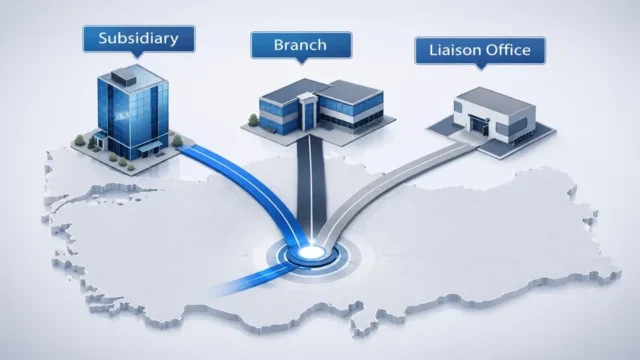
- You want to start commercial activity in Turkey right away, issue invoices and keep the corporate link with your parent company → a BRANCH is the right choice for you.
- You first want to get to know the market, carry out research and promotion, and have a presence in Turkey without trading → a LIAISON OFFICE is the right choice for you.
- You plan a long-term investment, want to limit your liability to your capital contribution and grow under a local corporate identity → a SUBSIDIARY (Ltd. or JSC) is the right choice for you.
Comparison Table: Branch – Liaison Office – Subsidiary
| Criteria | Branch | Liaison Office | Subsidiary (Ltd/JSC) |
|---|---|---|---|
| Legal personality | None – extension of the parent | None – representative office | Yes – independent Turkish company |
| Commercial activity | Permitted (sales, invoicing, tenders) | Not permitted (research, promotion, representation only) | Permitted – full capacity |
| Permit / registration authority | Ministry of Trade permit + Trade Registry registration | Ministry of Industry and Technology permit | Trade Registry registration (MERSİS) |
| Minimum capital | No statutory minimum; allocated capital is recorded in the registry | No capital requirement | Ltd: TRY 50,000 / JSC: TRY 250,000 |
| Corporate income tax | 25% (on Turkish-source income) | Exempt (cannot earn income) | 25% (on worldwide income) |
| Profit transfer | 15% withholding (reducible under tax treaties) | — | 15% dividend withholding (reducible under treaties) |
| Parent company liability | Unlimited – parent liable for all debts | Limited risk (no commercial transactions) | Limited to capital contributed |
| Setup time | 4–8 weeks | About 4 weeks (permit + registrations) | 1–2 weeks (with complete documents) |
| Duration | Indefinite | Initial permit up to 3 years; extendable | Indefinite |
| Annual obligations | Corporate tax return, E-TUYS notification | Annual activity report to the Ministry (by end of May each year) | Tax returns, general assembly, E-TUYS notification |
1) Opening a Branch in Turkey
What Is a Branch?
Under the Turkish Commercial Code (Law No. 6102, “TCC”), a branch is a business unit that is tied to the head office but runs its affairs with its own management and accounting, can transact with third parties, and is located at an address separate from the head office. A branch has no separate legal personality: every transaction it carries out belongs directly to the foreign parent company, which remains liable for all of the branch’s rights and obligations.
Advantages of Opening a Branch
- You can start commercial activity in Turkey directly – issue invoices and earn income.
- You can participate in public tenders and commercial contracts.
- You can employ staff (both Turkish and foreign employees).
- Compared with setting up a new company, you keep the corporate link and single balance-sheet structure with the parent.
- There is no statutory minimum capital (the capital allocated to the branch is recorded in the Trade Registry).
How to Open a Branch (Step by Step)
Registering a foreign company’s branch involves two permission layers: first a permit from the Ministry of Trade (General Directorate of Domestic Trade), then registration with the Trade Registry Directorate in the province where the branch will be located. The process runs as follows:
- The parent company’s governing body resolves to open a branch in Turkey and to appoint a fully authorised branch representative resident in Turkey.
- The parent company’s documents (registry certificate, articles of association, authorisation resolution, power of attorney) are prepared.
- The documents are apostilled or legalised through the Turkish consulate.
- All foreign-language documents are translated into Turkish by a sworn translator and notarised.
- The permit application is filed with the Ministry of Trade; the Ministry issues its permission letter and approved declaration (usually within 2–4 weeks).
- The registration application is prepared through MERSİS and filed with the Trade Registry Directorate.
- The branch is registered in the Trade Registry and announced in the Turkish Trade Registry Gazette (1–2 weeks).
- Tax office registration, social security (SGK) employer registration and bank account opening are completed.
- The establishment notification is filed through E-TUYS (the Electronic Incentive Implementation and Foreign Capital Information System).
Practical warning: the branch’s trade name must include the parent company’s full name, the locations of both the head office and the branch, and the word “branch” (TCC Art. 48/3). Applications that miss any of these elements are rejected by the registry, and the translation and apostille costs have to be repeated. Getting the trade name right from the start is one of the most critical steps in the process.
Documents Required for Branch Registration
- The parent company’s certificate of activity / registry extract (recently dated).
- The parent company’s articles of association (deed of incorporation) and any amendments.
- The governing body’s resolution on opening the branch and appointing the representative.
- A power of attorney (for the lawyer/representative handling the procedures in Turkey).
- The branch representative’s notarised signature declaration issued under the branch’s trade name.
- The representative’s identity and address documents (residence/work permit details for foreign representatives).
- The Ministry of Trade permission letter together with the approved (annex) declaration.
- Proof of the branch address (lease agreement or title deed).
All foreign documents must be apostilled (or consulate-legalised) and accompanied by notarised sworn Turkish translations. For the first branch, both home-country compliance and Turkish-law compliance are checked; subsequent branches of the same company go through a shorter process.
How Is a Branch Taxed?
A branch is a “limited taxpayer” in Turkey: it is taxed only on the income it earns in Turkey. The standard corporate income tax rate is 25%. When the branch transfers its profit to the parent company abroad, a 15% withholding tax applies; Turkey’s double taxation treaties can reduce this rate to 5–10% for most countries. To benefit from a treaty, the parent company’s tax residency certificate must be filed with the tax office before the transfer takes place.
2) Opening a Liaison Office in Turkey

What Is a Liaison Office?
A liaison office is a structure that allows foreign companies to carry out market research, representation, promotion and coordination activities in Turkey. It cannot engage in commercial activity, earn income or issue invoices. Opening a liaison office requires a permit from the Ministry of Industry and Technology, and the office operates under the Foreign Direct Investment Law (Law No. 4875) and its Implementation Regulation.
What Can a Liaison Office Do?
- Carry out market research and meet potential customers and suppliers.
- Conduct representation and promotion activities on behalf of the parent company.
- Prepare the parent’s investment plans for Turkey and serve as a regional management hub.
- Handle quality control, supplier audits and technical support coordination.
Tax Advantages of a Liaison Office
- Since it earns no commercial income, it is exempt from corporate income tax.
- Salaries paid to employees in foreign currency from abroad are exempt from income tax (Income Tax Law Art. 23/14).
- This makes the liaison office the most practical low-cost, low-risk way to test the Turkish market.
How to Open a Liaison Office (Step by Step)
- The parent company’s certificate of activity, activity report/balance sheet and authorisation documents are prepared; apostille and sworn translation formalities are completed.
- An application file and activity plan describing the activities to be conducted in Turkey are drawn up.
- The liaison office representative is designated and a power of attorney is issued.
- The application is filed with the Ministry of Industry and Technology (General Directorate of Incentive Implementation and Foreign Capital).
- Following the Ministry’s assessment, the permit is granted (usually within 15 business days if the file is complete).
- Tax office registration (potential taxpayer status) and, where needed, SGK workplace registration are completed.
- The office starts operating and files its activity report with the Ministry every year.
Documents Required for a Liaison Office
- The parent company’s current certificate of activity (apostilled).
- The parent company’s latest annual report or balance sheet and income statement.
- A certificate of authority for the person who will run the office’s activities.
- A power of attorney (for the person filing the application on the company’s behalf).
- The application form and undertaking describing the type and duration of the activities to be carried out in Turkey.
How Long Can a Liaison Office Operate?
Liaison offices are initially licensed for a maximum of 3 years. At the end of this period the permit can be extended, taking into account past activities and the parent company’s plans for Turkey. For certain special activity types other than market research and promotion, extension periods may differ. This is why defining the field of activity correctly in the application is critical for a smooth extension process.
3) Incorporating a Company in Turkey (Subsidiary)

What Is a Subsidiary?
A subsidiary is a separate capital company that the foreign parent incorporates in Turkey and that operates under Turkish law. The most common forms are the limited liability company (Ltd. Şti.) and the joint stock company (A.Ş.). Unlike a branch, a subsidiary has its own legal personality: it acquires rights, incurs debts, sues and can be sued in its own name. As a rule, the foreign parent is liable only up to the capital it has contributed – the single most important advantage over a branch.
Under Law No. 4875, foreign investors enjoy the same rights as Turkish investors: a company can be 100% foreign-owned, and no prior authorisation is required.
Limited Liability Company or Joint Stock Company?
- Limited Liability Company (Ltd. Şti.): minimum capital TRY 50,000. Can be founded with a single shareholder. Simpler to set up and manage – ideal for small and medium-sized investments. No capital blockage is required at incorporation; the capital can be paid within 24 months of registration.
- Joint Stock Company (A.Ş.): minimum capital TRY 250,000 (TRY 500,000 under the registered capital system). Can be founded with a single shareholder. Offers the path to a public offering, flexible share transfers and easier access to institutional investors. At least one quarter of the cash capital must be blocked in a bank before registration.
Company Incorporation Step by Step
- The company type, trade name, capital, shareholding structure and field of activity are determined.
- Tax identification numbers are obtained for the foreign shareholders (with a passport for individuals, with apostilled corporate documents for corporate shareholders).
- The articles of association are drafted and the application is created through MERSİS.
- The founders – or a lawyer authorised by power of attorney – complete the signature and registration formalities at the Trade Registry Directorate.
- For joint stock companies, 25% of the cash capital is blocked at a bank and the blockage letter is submitted to the registry; in addition, 0.04% of the capital is paid as the Competition Authority fee.
- The company is registered in the Trade Registry and announced in the Trade Registry Gazette – at this moment it acquires legal personality.
- The signature circular is issued and the statutory books are certified.
- The tax office inspection, SGK employer registration and bank account opening are completed.
- The foreign-capital company establishment notification is filed through E-TUYS.
With a complete set of documents, incorporation is usually finalised within 1–2 weeks. The founders do not need to travel to Turkey: with an apostilled power of attorney, the entire process can be handled remotely through your lawyer in Turkey.
Documents Required for Company Incorporation
For foreign individual shareholders:
- Notarised passport translation and tax identification number.
- Proof of residential address and a photograph.
For foreign corporate shareholders:
- Apostilled and sworn-translated certificate of activity (registry extract).
- The governing body’s resolution on participating in the incorporation in Turkey and appointing a representative (apostilled).
- An apostilled power of attorney for the person handling the incorporation.
Common documents:
- The articles of association prepared through MERSİS.
- The directors’ declarations of acceptance of office and signature declarations.
- The lease agreement or title deed for the registered office address.
- For joint stock companies, the bank blockage letter and the Competition Authority fee receipt.
The 5 Most Common Mistakes Foreign Investors Make
- Getting the branch trade name wrong under the TCC: the process drags on and apostille and translation costs are repeated. The structure and the trade name must be set up correctly from the very beginning.
- Skipping the E-TUYS notification: registration is completed but the E-TUYS filing is forgotten. This gap creates serious problems in capital movements, banking transactions and incentive applications.
- Trading through a liaison office: issuing invoices or signing contracts in the liaison office’s name leads to cancellation of the permit and tax penalties.
- Failing to use double taxation treaties in time: if the parent’s tax residency certificate is not filed before the profit transfer, the full 15% withholding applies instead of the reduced treaty rate – and the refund procedure takes months.
- Not documenting the capital transfer: if the capital is not brought into Turkey through banking channels with the correct references, proving it later becomes a problem when repatriating profits and capital.
Frequently Asked Questions (FAQ)
How long does it take to open a branch in Turkey?
With a complete file, the Ministry permit takes 2–4 weeks and the registry registration 1–2 weeks – 4–8 weeks in total.
Is there a minimum capital for a branch?
There is no statutory minimum; however, the capital allocated to the branch is recorded in the Trade Registry and is taken into account in work permit applications and banking transactions. Set a realistic figure, not a symbolic one.
Can a liaison office issue invoices?
No. A liaison office cannot engage in commercial activity, earn income or issue invoices. For commercial activity you need a branch or a company.
Can a foreign company own 100% of a Turkish company?
Yes. Under Law No. 4875, foreign investors enjoy equal treatment with local investors, and 100% foreign ownership is freely permitted.
Can I set up a company or branch without travelling to Turkey?
Yes. With an apostilled and translated power of attorney, all incorporation, tax and banking formalities can be completed remotely through your lawyer in Turkey.
Does the branch representative have to be a Turkish citizen?
No. The representative only needs to be resident in Turkey; foreign nationals can take on this role with a residence or work permit.
Does the full capital of a limited company have to be paid at incorporation?
No. In a limited company the capital can be paid within 24 months after registration. In a joint stock company, at least 25% of the cash capital must be blocked before registration.
Are liaison office employees’ salaries taxable?
Salaries paid from abroad in foreign currency are exempt from income tax. Social security contributions are paid under the general rules.
Why Turkey?
If you are planning to enter a new market, Turkey should be near the top of your list. Its strategic location gives you easy access to the markets of Europe, Asia and the Middle East, while its strong manufacturing base, large domestic market and dynamic economy let you grow your business with confidence. Thanks to the legal safeguards granted to foreign investors and the principle of equal treatment, many international companies choose to continue their growth journey in Turkey.
Why Does Legal Guidance Matter on This Journey?

Deciding to invest in a foreign country is about much more than preparing documents and filing applications. Choosing the right structure, running the permit procedures without gaps and planning tax obligations in advance are decisive for a safe start. Sound legal planning at the outset prevents lost time, extra costs and potential legal risks down the road.
Tercan Legal Is by Your Side Throughout Your Investment in Turkey

At Tercan Legal, we see a foreign investor’s journey in Turkey as far more than the incorporation formalities. From choosing the right structure to official permit applications, from preparing corporate documents to tax planning, and on to post-incorporation contracts and compliance, we provide comprehensive legal counsel at every step. Since 2013 we have served clients from more than 40 countries in 7 languages – securing your investment in Turkey from day one.
Contact us for your branch, liaison office or company formation – let’s determine the structure that fits you best, together.
This article is provided for general informational purposes and does not constitute legal advice. Investment thresholds and procedural requirements are set by Turkish law and regulation and may be updated over time. For guidance tailored to your specific situation, please contact us directly.